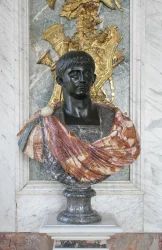
Claudius
 Ancient Rome
Claudius came to power in a scene that seemed almost accidental: after the assassination of his nephew Caligula, Praetorian Guards found him hiding in the palace and proclaimed him emperor. Long dismissed by his family as physically awkward and politically unfit, he proved to be an energetic ruler and a serious student of Roman history. His reign expanded Roman territory, strengthened imperial administration, and launched the conquest of Britain. It also ended amid court intrigue and the succession of Nero.
An Unexpected Emperor
Born at Lugdunum, modern Lyon, in 10 BCE, Claudius was the son of Nero Claudius Drusus and Antonia Minor. Ancient accounts describe him as having a limp and speech difficulties, conditions that kept him largely away from public office under earlier emperors. He devoted himself to scholarship, writing histories and studies of Roman institutions. Most of his works have been lost, but his intellectual interests set him apart from the image of a ruler shaped only by military ambition.
In January 41 CE, Caligula was murdered by members of the Praetorian Guard. Claudius, Caligula’s uncle, was discovered in the palace and declared emperor by the soldiers. His accession was not a carefully planned transfer of power, but he quickly established himself as head of state. He relied on a close circle of advisers and imperial freedmen, whose influence reflected the growing importance of the emperor’s household in the government of Rome.
Conquest and Administration
One of Claudius’ most famous achievements was the invasion of Britain in 43 CE. Roman forces under Aulus Plautius began the campaign, and Claudius himself traveled to the island to claim a symbolic role in the victory. The conquest extended Roman rule beyond Gaul and became a defining achievement of his reign, though resistance continued long after the initial advance.
At home, Claudius took an active interest in legal cases and administration. He expanded the imperial bureaucracy and relied on officials who handled correspondence and finances. His government also pursued large public works, including improvements to Rome’s water supply and the harbor at Ostia, intended to ease the city’s dependence on an unreliable grain supply. He extended Roman citizenship in some provinces and strengthened the emperor’s role in governing a far-flung empire.
Family, Succession, and Death
Claudius’ household was a center of political maneuvering. His third wife, Valeria Messalina, was executed in 48 after a dramatic court crisis. He later married Agrippina the Younger, his niece, and adopted her son Nero as his heir, placing him ahead of Claudius’ own son Britannicus. The decision shaped the next imperial succession.
Claudius died in 54 CE, and Nero became emperor. Ancient writers widely reported that Claudius had been poisoned, often blaming Agrippina and describing a dish of mushrooms, but they disagreed about the details. The precise cause and circumstances remain uncertain.
Remembered through hostile as well as admiring ancient accounts, Claudius is difficult to reduce to either a bumbling figure or an administrative success. His unexpected rise, expansion into Britain, public works, and complicated court politics reveal an emperor who shaped the Roman state while remaining vulnerable to the family rivalries surrounding the throne.