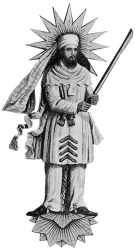
Jeremiah
 Kingdom of Judah
Jeremiah’s story unfolds as the kingdom of Judah approaches catastrophe. In the biblical narrative, he warns kings and citizens that resistance to Babylon will bring disaster, yet his message earns him hostility, imprisonment, and isolation. The book associated with his name is unusually personal, mixing prophetic poetry with scenes from a turbulent life and voices of grief, anger, and hope.
Called to speak in a time of crisis
The Book of Jeremiah identifies him as the son of Hilkiah, from the priestly town of Anathoth near Jerusalem. It places the beginning of his prophetic mission in the thirteenth year of King Josiah, around 627 BCE. Jeremiah’s ministry continued through the reigns of several kings, as Babylon rose to power and Judah’s independence grew increasingly precarious.
Jeremiah’s message was a difficult one. He condemned injustice and the worship of other gods, and warned that Jerusalem would fall if its leaders continued to ignore the covenant. He urged the people not to mistake the Temple’s presence for a guarantee of safety. When the king of Babylon demanded submission, Jeremiah advised Judah’s rulers against rebellion, arguing that resistance would only deepen the suffering.
A prophet opposed and imprisoned
The book recounts how Jeremiah’s warnings made him a target. Priests and officials accused him of undermining the people’s morale. King Jehoiakim burned a scroll containing Jeremiah’s words, but Jeremiah dictated them again to his scribe Baruch, adding further material. Under King Zedekiah, he was imprisoned and later lowered into a muddy cistern, from which a court official rescued him.
In 586 BCE, Babylonian forces captured Jerusalem, destroyed the Temple, and deported many of Judah’s people. Jeremiah remained among a remnant left in the land, but when they later fled toward Egypt, they took him with them. The biblical account does not provide a clear ending to his life, and later traditions about his death are uncertain.
Words of judgment and renewal
The Book of Jeremiah is not a straightforward biography. It brings together poems, sermons, symbolic actions, letters, and narrative episodes, and its arrangement differs between ancient textual traditions. The book presents Jeremiah as both a public critic of political choices and a deeply emotional figure who laments the destruction he foresaw. He is often called the “weeping prophet,” reflecting the grief woven through his words.
Alongside warnings of judgment, Jeremiah also offers hope. One of the book’s best-known passages looks toward a “new covenant,” written not on stone but on people’s hearts. This vision of renewal became important in both Jewish and Christian interpretation.
Jeremiah’s legacy rests in the tension at the heart of his story: he speaks against the hopes of his own people because he believes truthful warning can spare them greater harm. The book that bears his name preserves both the cost of that dissent and the hope that disaster would not be the final word.