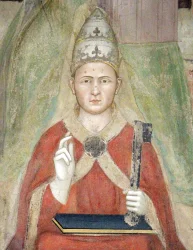
Clement V
- From Gascon archbishop to pope
- A papal court on the move
- The Templars and the Council of Vienne
- Final years and legacy
For nine turbulent years at the start of the fourteenth century, Pope Clement V tried to hold the medieval Church together while Europe’s most powerful monarchs pressed hard against papal authority. His pontificate is remembered above all for the papal court’s move to Avignon and the dissolution of the Knights Templar, but the story is less simple than the image of a pope merely doing a French king’s bidding. Clement bargained, stalled, and sometimes resisted; his choices nonetheless reshaped the Church and left a complicated legacy.
From Gascon archbishop to pope
Born Bertrand de Got in Villandraut, in the region of Gascony, he came from a noble family with deep ties to the local church. He studied canon and Roman law at Orléans and Bologna, then advanced through a series of clerical offices. In 1295 he became bishop of Comminges, and in 1299 Pope Boniface VIII appointed him archbishop of Bordeaux. The post placed him in the middle of a region contested by the French and English crowns, a useful preparation for the diplomatic pressures he would later face.
After Pope Benedict XI died in 1304, the cardinals spent nearly a year struggling to choose a successor. They elected Bertrand on June 5, 1305. He took the name Clement V and was crowned at Lyon that November. His connections to both Boniface VIII and Philip IV of France helped make him acceptable to rival factions, but Philip’s support also fueled suspicion that the new pope would serve French interests.
A papal court on the move
Clement never settled in Rome. The political turmoil of Italy, the need to negotiate with rulers, and his own ties to southern France kept the curia moving among cities. In 1309 he established his residence at Avignon, then a papal fief held by the kingdom of Naples. This decision began the long period in which popes governed from Avignon, although the later image of a permanent “Avignon Papacy” took shape over time rather than all at once under Clement.
His relationship with Philip IV was close but not effortless. The king sought papal action against his predecessor Boniface VIII and demanded a reckoning with the Templars, a wealthy military religious order. Clement tried to avoid a direct clash with the crown while preserving the Church’s right to judge its own affairs. At times he granted concessions; at others he slowed or redirected the king’s plans.
The Templars and the Council of Vienne
In 1307 Philip ordered the arrest of Templars in France on charges that included heresy and other abuses. Under interrogation, some members confessed, while many later recanted; the reliability of the proceedings became a central issue. Clement called a general council, which met at Vienne from 1311 to 1312, to consider the order’s fate and broader questions facing the Church.
The council did not reach a clear finding that the Templars as an order were guilty of heresy. In March 1312, however, Clement issued the bull “Vox in excelso,” suppressing the order by papal authority rather than through a definitive judicial condemnation. The distinction mattered: it let the pope end the crisis without declaring the charges proven. The order’s possessions were assigned largely to the Hospitallers, though the French crown retained substantial wealth seized in France. The episode remains the defining example of how royal force and papal calculation collided during Clement’s reign.
The Council of Vienne also considered plans for a crusade and reform within the Church. Clement’s work as a jurist left another mark: a collection of canon law known as the “Clementinae” was prepared during his pontificate and promulgated by his successor, John XXII. In 1313 Clement canonized Celestine V, the pope who had resigned the papacy in 1294.
Final years and legacy
Clement’s health declined during his final years. He died at Roquemaure, near Avignon, on April 20, 1314, and was buried at Uzeste in his native region. His papacy had strengthened the role of the French court in church affairs and begun a long absence of the papal court from Rome. Yet he was not simply a royal instrument: his handling of the Templars and his defense of Boniface VIII’s memory show a pope working to protect institutional authority even while making painful compromises.
Clement V is remembered as a cautious and politically constrained leader whose decisions changed the geography of papal power. His reign did not settle the struggle between monarchs and the Church; it made that struggle impossible to ignore.