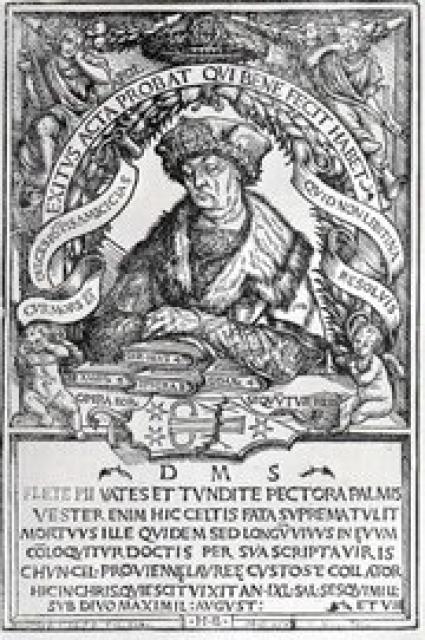
Conrad Celtis
 Germany
- Biography of Conrad Celtis
- Contributions to German Humanism
- Promotion of Education and Enlightenment
- Literary Achievements
- Bibliography
Biography of Conrad Celtis
Conrad Celtis (1 February 1459 – 4 February 1508, Vienna) was an outstanding German humanist of the late 15th and early 16th centuries. He is considered the most significant neo-Latin poet in Germany during the Renaissance period.
Contributions to German Humanism
Celtis aimed to "enhance the glory of his homeland" and believed that the center of the new culture could shift from Italy to Germany. He founded, strengthened, and inspired new humanistic associations in various cities where he conducted his scientific and teaching activities. Celtis proposed a comprehensive program of collective work for German humanists. He advocated for the collection, study, and publication of sources that shed light on the history, ethnographic and geographic characteristics, and cultural achievements of Germany throughout different centuries. He also advocated for political centralization in Germany, dreaming of a time when the feuding between princes would cease.
Promotion of Education and Enlightenment
Mocking the ignorance and vices of the clergy, Celtis defended the necessity of a close connection between the humanities and mathematical disciplines, as well as the study of nature. He fervently promoted secular education. His works presented Celtis in various, often inconsistent guises: sometimes as an enthusiastic admirer of classical antiquity, sometimes as a supporter of renewed Christian piety tinged with neo-Platonism, and sometimes as an apologist for an ancient, supposedly authentically Germanic religion, largely created by Celtis' rich poetic imagination.
Literary Achievements
Celtis' versatility was also evident in his poetry. In his "Four Books of Love Elegies Corresponding to the Four Sides of Germany," the poet's descriptions of his own love experiences intertwined with characterizations of women of different temperaments, complex and multivalent symbolism, and finely delineated landscapes. Despite the contradictions in Celtis' views, the humanistic spirit remained the central pillar of his works.
Bibliography
History of Culture in Western European Countries during the Renaissance Period. Edited by L. M. Bragina. Moscow: Higher School, 2001.


