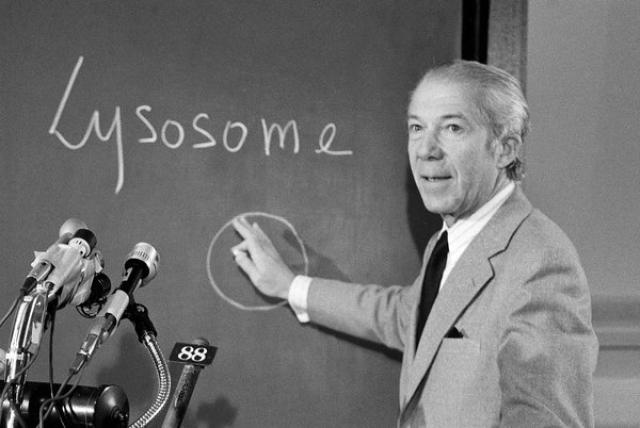
Cristian Rene De Duve
 Belgium
- Biography of Christian Rene de Duve
- Early Education and Medical Career
- Research on Cellular Fractionation
- Discovery of Lysosomes and Peroxisomes
- Later Career and Contributions
Biography of Christian Rene de Duve
Christian Rene de Duve was a Belgian cytologist and biochemist, who was awarded the Nobel Prize in Physiology or Medicine in 1974. He was born to Madeleine de Duve (née Pungs) and Alphonse de Duve, Belgian citizens who sought refuge in the UK during World War I. In 1920, the family returned to Belgium and settled in Antwerp, where Christian received his education in both French and Flemish languages.
Early Education and Medical Career
In 1934, Christian enrolled at the Catholic University of Leuven, initially pursuing a humanities-focused education at a Jesuit school. However, his interest in medicine led him to shift to a higher medical institution in Leuven, where he worked in the physiological laboratory of J. Bucquoy. He studied the process of glucose utilization by cells. By the time he obtained his medical degree in 1941, Christian had firmly set his goal to understand the mechanism of insulin action, a hormone that regulates the use of glucose in the body.
During World War II, Christian briefly served in the Belgian army before being captured and escaping back to Leuven. He completed a four-year university course and obtained a degree in chemistry. He also worked as a resident physician at the clinic under the guidance of Joseph Mezern, diligently studying insulin-related literature and conducting experiments in the laboratory. By 1945, Christian had published several scientific papers and authored a book titled "Glucose, Insulin, and Diabetes."
Research on Cellular Fractionation
In 1946, Christian received a Master's degree and subsequently worked for 18 months at the Nobel Medical Institute in Stockholm, in Hugo Theorell's laboratory. He then spent 6 months at Washington University in St. Louis, as a Rockefeller Foundation fellow. It was during this time that he met Carl F. and Gerty T. Cori. Additionally, at Washington University, he had the opportunity to collaborate with Earl W. Sutherland. Upon returning to Belgium, Christian became a biochemistry lecturer at the Medical School of the Catholic University of Leuven, where he established a research laboratory.
Driven by his desire to understand the mechanism of insulin action, Christian conducted a series of experiments to study the properties of enzymes in liver cells involved in glucose metabolism. This required separating the cells into individual components through centrifugation. Different cell fragments settled in different layers of the test tube based on their sizes, shapes, and densities, allowing them to be studied separately. Christian and his colleagues at the University of Leuven further refined this method, known as analytical cell fractionation, which enabled the analysis of separated fractions. This new method provided additional information about the enzymatic activity of specific fractions and, in particular, the activity of organelles - the intracellular structures that perform specific functions for the cell as a whole.
Discovery of Lysosomes and Peroxisomes
Christian's first major achievement was the discovery of new organelles called lysosomes. In 1949, he and his team found that the activity of acid phosphatase, an enzyme found in liver cell mitochondria, significantly increased on the fifth day after fractionation compared to the first day. Christian explained this by proposing the existence of another cytoplasmic organelle, the stability of which was responsible for the delayed enzyme activity manifestation. In the early 1950s, Christian and his colleagues discovered another subcellular organelle containing the enzyme uricase, which they named peroxisomes.
Christian and his team then focused on studying the functions of these two newly discovered organelles - a problem that many other researchers were also working on. In 1983, Christian described lysosomes as small membrane-bound vesicles that contain numerous enzymes involved in intracellular digestion of nutrients, foreign substances, and sometimes even the cell itself. Lysosomes are abundant in the liver and kidney cells of mammals. As for peroxisomes, which are widely distributed in plant and animal cells, they appear to perform two metabolic functions: converting various intracellular molecules into hydrogen peroxide, which is subsequently reduced to water, and facilitating the conversion of intracellular proteins into glucose. However, unlike mitochondria, neither lysosomes nor peroxisomes can serve as an energy source for the cell.
Later Career and Contributions
In 1951, Christian became a professor of physiological chemistry at Leuven. In 1962, he took up the position of professor of biological cytology at Rockefeller University in New York. These positions allowed him to continue his research on the functions of the two organelles he discovered. In 1962, he co-founded the International Institute of Cellular and Molecular Pathology at the newly established Medical School in Brussels. In 1974, Christian, along with Albert Claude and George E. Palade, received the Nobel Prize in Physiology or Medicine "for their discoveries concerning the structural and functional organization of the cell." In his Nobel lecture, Christian emphasized the importance of understanding enzyme structure and the organization of enzymes in cellular structures.
After receiving the Nobel Prize, Christian conducted numerous scientific investigations, although the practical applications of his findings are yet to be fully realized. He studied the properties and functions of lysosomes and peroxisomes under normal and various disease conditions. He and his colleagues demonstrated that deficiencies in lysosomal enzymes could be a pathogenetic factor in 20 different disorders characterized by abnormal accumulation of glycogen, lipids, and mucopolysaccharides. Christian also hypothesized that lysosomes and their enzymes may be involved in tissue aging and degradation. Additionally, he and his colleagues explored the effects of drugs, such as steroid hormones, that suppress inflammatory reactions in tissues, showing that they can affect lysosomal membranes. They also aimed to develop substances that enhance the efficacy and reduce the side effects of drugs used in chemotherapy for leukemia.
Christian married Janine Herman, the daughter of a physician, in 1943. They have two sons and two daughters. Christian currently holds positions in both New York and Brussels, dividing his time between the two laboratories. He enjoys playing bridge, skiing, and tennis.
In addition to the Nobel Prize, Christian has received the Pfizer Award from the Belgian Royal Academy of Medicine (1957), the Franqui Foundation Prize (1960), the Gardner Foundation Special Honor Award (1967), and the Heineken Prize from the Royal Netherlands Academy of Sciences (1973). He is a member of the Belgian Royal Academy of Medicine, the Pontifical Academy of Sciences, the American Academy of Arts and Sciences, and the National Academy of Sciences of the USA. He has received honorary degrees from over 10 different American and European universities.


