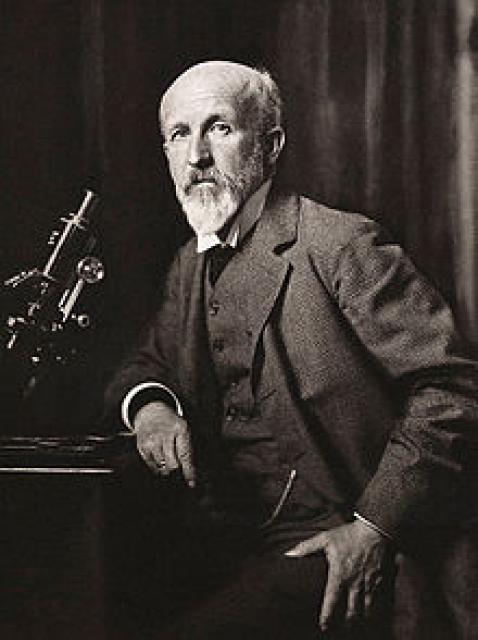
Oscar Hertwig
 Germany
- Biography of Oscar Hertwig
- The Hertwig Brothers
- Contributions to Science
- German Zoologist and Professor
- Recognition
Biography of Oscar Hertwig
Oscar Hertwig, a German embryologist and cytologist, was born into a wealthy merchant family in Friedberg. Soon after his birth, the family moved to Mülhausen in Thuringia, where Oscar and his younger brother Richard received their education at a secondary school. After graduating from school in 1868, the Hertwig brothers enrolled at the Friedrich Schiller University in Jena.
The Hertwig Brothers
Oscar was the older brother of the zoologist Richard Hertwig (1850-1937). Together, they became the most renowned students of Ernst Haeckel and Carl Gegenbaur during their teaching tenure in Jena. While not accepting Haeckel's philosophical speculations, they nevertheless utilized his ideas to expand their zoological concepts. Their first research from 1879 to 1883 was in the field of embryology, and their work was based on the biogenetic law. In 1881, the Hertwig brothers published an extensive work on the theory of the coelom.
Contributions to Science
Oscar Hertwig was a leading figure in the field of comparative and causal developmental biology and authored a leading textbook in this area. Using sea urchins as a model organism, he first described the process of nuclear fusion during fertilization, studied the role of the cell nucleus in inheritance, and the phenomenon of meiotic reduction. Concurrently with his research in developmental biology, Hertwig opposed Charles Darwin's theory. His most significant publication in this area was the 1916 book "Das Werden der Organismen, eine Widerlegung der Darwinschen Zufallslehre" ("The Origin of Organisms, a Refutation of Darwin's Theory of Chance").
German Zoologist and Professor
In 1888, Oscar Hertwig became a professor of anatomy in Berlin, while Richard held the position of professor of zoology at the Ludwig Maximilian University from 1885 to 1925.
Recognition
In 1903, Hertwig was elected a member of the Royal Swedish Academy of Sciences. His groundbreaking research and critical contributions to the fields of embryology, cytology, and developmental biology established him as one of the leading scientists of his time.


