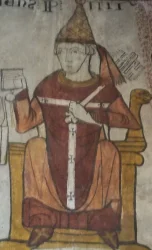
Damasus II
Damasus II occupied the papal throne for only a few weeks in 1048, but his brief pontificate unfolded during a turbulent struggle over who would control Rome’s church. Born Poppo, he had served as bishop of Brixen before Emperor Henry III selected him as pope. His short reign reflects the influence of imperial politics at a time when rival factions in Rome competed to shape the papacy.
From Bishop Poppo to Pope
Poppo came from the German lands, traditionally identified as Bavaria or Tyrol, and was associated with Brixen, a bishopric in the Alpine region. Details of his early life are sparse. He appears in records as bishop by 1040 and accompanied Henry III on the emperor’s Italian expeditions and church councils.
The papacy was unsettled in the years before Poppo’s elevation. Pope Clement II, chosen with imperial backing, died in 1047. Benedict IX, who had previously resigned the office, returned to Rome and again claimed the papacy with the support of the powerful Tuscan margrave Boniface. A Roman delegation then appealed to Henry III to choose a successor to Clement.
Henry selected Poppo, who was then bishop of Brixen, and instructed Boniface to escort him to Rome. Boniface initially resisted while Benedict IX remained in the city. The emperor’s pressure eventually secured his cooperation, and Benedict was removed. Poppo entered Rome and was consecrated pope on July 17, 1048, taking the name Damasus II.
A Reign of Twenty-Three Days
Damasus’s pontificate lasted until August 9, just twenty-three days. With so little time in office, the historical record offers little evidence of a distinct program or major policy decisions. His elevation itself reflected Henry III’s influence: the emperor had chosen him as part of a wider effort to restore order and strengthen imperial influence over the church.
After his consecration, Damasus went to Palestrina, outside Rome. He died there on August 9, 1048. Medieval accounts report that he died of a fever, often identified by later historians as malaria, which was common in the region. Rumors that he had been poisoned circulated, but the evidence does not establish that claim.
His body was taken back to Rome and buried at the Basilica of San Lorenzo fuori le mura. Leo IX succeeded him in 1049, continuing the series of German-born popes supported by Henry III.
Legacy
Damasus II is remembered chiefly for the brevity of his pontificate and the political circumstances of his appointment. His story is not one of a long papal administration but of a church caught between Roman aristocratic factions and the claims of imperial authority. With only three weeks as pope, he left little personal imprint on church policy. Yet his brief passage through the office stands as a vivid episode in the mid-eleventh-century struggle to stabilize the papacy.