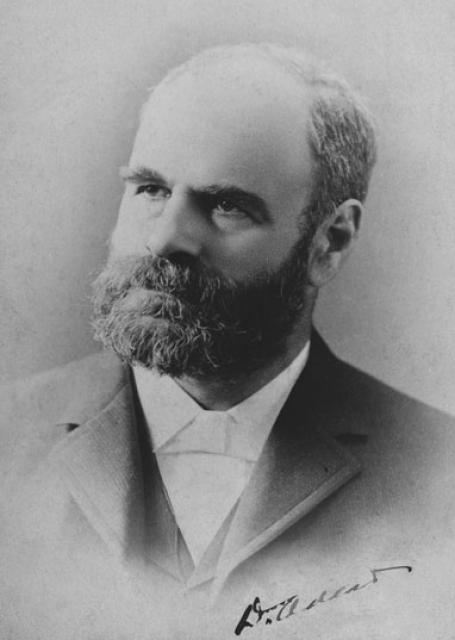
Dankmar Adler
 USA
USA- Louis Henri Sullivan: The Father of Skyscrapers
- Formative Years and European Influence
- Return to Chicago and Partnership with Dankmar Adler
- Architectural Innovations and the Skyscraper
- - The ornament should be organic and integrated into the design
- Legacy and Recognition
Louis Henri Sullivan: The Father of Skyscrapers
Early Life and InspirationBorn on September 3, 1856, in Boston, Massachusetts, Louis Henri Sullivan's architectural journey began at a young age. At 12, he witnessed the construction of a building and was captivated by the authority wielded by the architect. Determined to pursue this path, he enrolled in the Massachusetts Institute of Technology at 16. However, he found the curriculum uninspiring, believing it focused on craftsmanship rather than true artistry.
Formative Years and European Influence
Sullivan aspired to study at Paris's École des Beaux-Arts. To prepare, he took lessons from Monsieur Clope, who emphasized the importance of universal principles that could solve any design problem. This became known as Sullivan's "Clope Principle." In 1874, he finally traveled to France and enrolled in the prestigious École. Despite the language barrier, he excelled in his studies and developed a deep appreciation for French aesthetics.
Return to Chicago and Partnership with Dankmar Adler
Upon returning to Chicago in 1875, Sullivan found limited opportunities due to his lack of connections. However, in 1879, he joined forces with Dankmar Adler, who had a contract to build the Central Music Hall. Sullivan's innovative ideas impressed Adler, and they became full partners a year later, forming Adler & Sullivan.
Architectural Innovations and the Skyscraper
Sullivan recognized the need for tall buildings as cities expanded and land became scarce. He developed a revolutionary concept for skyscrapers, using external supports and isolated foundations to reduce the weight-bearing capacity of walls. This allowed for larger windows and increased natural light, while maximizing usable floor space.
Wainwright Building: The Epitome of Sullivan's Architectural Philosophy
In 1890, Sullivan designed the Wainwright Building in St. Louis, which embodied his principles of skyscraper design:
- The exterior should reflect the building's function as a commercial structure
- The ornament should be organic and integrated into the design
- The building should be safe and structurally sound- The building should be economical to construct
- The building should be beautiful
The Auditorium Building: A Triumph of Design and Commerce
In 1887, Sullivan and Adler won the contract to design the Auditorium Building in Chicago. It featured a 17-story tower, a 4,232-seat concert hall, and various commercial spaces. The project was a monumental success and showcased Sullivan's architectural genius.
Legacy and Recognition
Louis Henri Sullivan is widely regarded as the inventor of the skyscraper. His architectural innovations and emphasis on form and function had a profound impact on 20th-century architecture. He was inducted into the National Building Museum's Hall of Fame in 1985. Although his partnership with Adler dissolved in 1895, Sullivan continued to design innovative buildings until his death on April 14, 1924. His legacy as a visionary architect remains firmly established.


