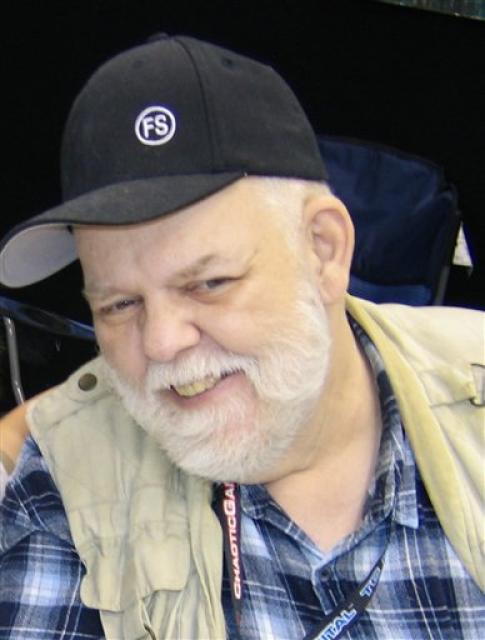
Dave Arneson
 USA
USABiography of Dave Arneson
Dave Arneson, an American game designer, is known as the creator of the first published tabletop role-playing game, "Dungeons & Dragons". He worked on this game in the early 1970s together with Gary Gygax. Arneson laid the foundations of the role-playing game genre, developing the concept and classic features such as adventures in dungeons, the presence of a neutral referee, and dialogues with imaginary characters to progress through the storyline.

Arneson's interest in game design stemmed from his fascination with war games. In the 1960s, as a teenager, Arneson discovered the tabletop war game "Gettysburg" and began combining it with role-playing elements. He studied at the University of Minnesota, where he met Gary Gygax at the Gen Con festival. In the 1970s, Arneson created a medieval fantasy world called "Blackmoor" and a role-playing game of the same name based on his own rules. He showed the game to Gygax, and together they developed a set of new rules that eventually became "Dungeons & Dragons". Gygax then founded TSR, Inc. to publish the game in 1974. Arneson also worked for this company for a while before leaving in 1976. In 1979, he filed a lawsuit to protect his authorship and receive royalties.
Arneson continued to work as an independent game designer and briefly returned to TSR in the 1980s. He was also involved in computer programming and taught computer game design and rule development at Full Sail University from the 1990s until his retirement in 2008.
Arneson's vision for game design grew from his love for war games. In the 60s, he often participated in historical reenactments during college and enjoyed creating alternative scenarios and developing alternative history.
In October 1970, Arneson began envisioning a fantasy version of the war game "Braunstein", where players could explore dungeons filled with fantastic monsters. At first, Arneson used his own set of rules, using "Rock, Paper, Scissors" to determine battle outcomes, but later adapted a combat system borrowed from war games. In the spring of 1971, Gary Gygax and Jeff Perren released a modified version of the game "Chainmail", which served as a catalyst for Arneson's creation of the first role-playing game called "Blackmoor". The game system in "Blackmoor" closely resembled "Dungeons & Dragons", featuring hit points, armor classes, character development, and dungeons.
Arneson's "Blackmoor" caught Gary Gygax's attention, and Gygax started developing his own game campaign called "Greyhawk". He asked Arneson to provide him with drafts of game rules. Arneson and Gygax communicated extensively by phone and mail, involving others in playtesting the game. Based on Arneson's ideas, "Dungeons & Dragons" was born. They were eager to publish the game, but major publishers, such as Guidon Games and Avalon Hill, rejected their proposals. Arneson's financial situation didn't allow him to invest in such a venture, but Brian Blume agreed to fund the publication. In 1974, the first edition of "Dungeons & Dragons" was released with a print run of 1000 copies, and it quickly sold out.
In 1975, a book containing the original rules from "Blackmoor" was published as an addition to "Dungeons & Dragons". In early 1976, Arneson formally joined TSR but left by the end of the year to pursue a career as an independent game designer. Nevertheless, in 1977, Arneson published the booklet "Dungeonmaster's Index" as an appendix to "Dungeons & Dragons".
TSR agreed to pay Arneson royalties for all products related to "Dungeons & Dragons". However, when "Advanced Dungeons & Dragons" was released in 1977, TSR refused to pay Arneson, claiming it was a completely different product. Arneson fought for his rights, and he was recognized as a co-author of the publication.
Throughout his life, Arneson continued to play tabletop games. In the last two years of his life, he battled cancer and passed away on April 7, 2009. Arneson's daughter, Maria Weinhagen, described him as someone who wanted people to enjoy life. She said, "I think we often get upset about everyday nonsense that we have to endure and forget to enjoy life and find pleasure in it."