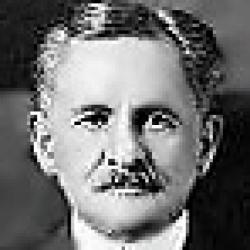
Denes Gabor
 Hungary
- Childhood and Education
- Military Service and Early Career
- Career in Physics
- Electronic Optics and World War II
- Development of Holography
- Principle of Holography
Childhood and Education
Dénes Gábor was born in Budapest, Hungary, on June 5, 1900, as the eldest of three sons to Adrienne (Kalman) and Bertalan Gábor. His mother was a former actress, while his father, the grandson of a Jewish Russian immigrant, rose to become the director of the Hungarian General Coal Company, the largest industrial enterprise in Hungary. The family held a deep admiration for intellectual pursuits, fostering an atmosphere of learning and achievement at home.
After graduating from local schools, Gábor attended the Miklos Toldi State Secondary School, where he excelled in languages, mathematics, and natural sciences. He demonstrated an early aptitude for physics and, together with his brother Djerd, conducted experiments in their home laboratory based on what they read in scientific books and journals.
Military Service and Early Career
In 1918, Gábor was conscripted into military service in the waning months of World War I. He underwent officer training for artillery and cavalry and was assigned to the Italian front in the fall of that year. After the war's end, he was transferred back to Hungary and demobilized in November 1918.
Upon returning home, Gábor enrolled in the Budapest Polytechnic University, pursuing a four-year program in mechanical engineering. At the time, obtaining employment as a physicist in Hungary was nearly impossible. During his third year, he was again conscripted into the army. Opposing the monarchy that had been restored in Hungary in 1920, Gábor evaded the call-up and moved to Berlin, Germany, to complete his education at the Berlin Technical University, graduating in 1924 as an engineer. While in Berlin, he frequently visited the University of Berlin, attending lectures by renowned scientists such as Max Planck, Walter Nernst, Max von Laue, and attending Albert Einstein's seminar.
Career in Physics
After earning a doctorate in electrical engineering in 1927, Gábor worked at the Siemens & Halske Company's physics laboratory in Siemensstadt. Among his accomplishments there was the invention of the quartz mercury lamp. Following the rise of Hitler to power in 1933, Gábor returned to Hungary after the expiration of his contract with Siemens & Halske. Working as an external member of the research institute of the Tungsram Electron Tube Works, he created a novel type of fluorescent lamp, which he called a plasma lamp. Unable to market his patent in Hungary, Gábor decided to emigrate to England.
In 1934, Gábor secured a position at the British Thomson-Houston (BTH) Company, where he remained until 1948. He became a British citizen in 1946. At BTH, Gábor attempted to improve his plasma lamp, but the project was eventually abandoned in 1936 due to insurmountable technical difficulties. From 1937 to 1948, he focused his research primarily on electron optics, a field concerned with the control and focusing of electron beams.
Electronic Optics and World War II
During World War II, Gábor's work on electron optics was disrupted. As a non-British citizen at the time, he was barred by the authorities from directly participating in defense programs. His attempt to enlist in the army was denied, although he was later placed on a list of privileged aliens. This status allowed him to continue his research but excluded him from access to classified information. As a result, he worked in a small cottage outside BTH's secure facility during the war. Unaware of the ongoing work on radar, Gábor devised a system that he envisioned could detect aircraft by the heat emitted from their engines.
The war also affected Gábor's personal life. In December 1938, his brother Andre joined him in England, and Gábor persuaded him to stay permanently. He repeatedly urged his parents to join him, but they returned to Hungary just before the German invasion of Poland. Gábor's father died in 1942, while his mother survived the war and moved in with him in 1946.
Development of Holography
Shortly before the end of the war, Gábor resumed his research in electron optics, beginning the work that would ultimately lead to his creation of holography. His initial aim was to improve the electron lens, a device that focuses electron beams just as a glass lens focuses light rays. Such a lens was used primarily in the electron microscope, invented in 1933 by Ernst Ruska. It allowed for highly magnified imaging by directing a beam of electrons onto an object and focusing the reflected electrons onto a specially treated screen.
According to quantum mechanics, electrons, like light, exhibit wave-like properties. Since the wavelengths of fast electrons are much shorter than the wavelengths of light, the electron microscope has the potential to resolve much finer details than optical microscopes. In the 1930s, electron microscopes were limited in their resolution by imperfections in electron lenses. Beyond certain levels of magnification, the lenses distorted the image, leading to the loss of some information. Gábor became intrigued by the question of whether it was possible to take an imperfect electron image, which contained all the information, and correct it using optical means. In other words, he sought to use light to magnify and "read" the image produced by electron beams.
In 1947, Gábor developed the theory underlying such a method and, in 1948, coined the term holography (from the Greek words "holos" for whole and "gram" for recorded). Gábor demonstrated the feasibility of his approach not using electron beams but with light rays. Even today, holography is primarily used as an optical rather than an electron-optical technique.
Principle of Holography
Exploiting a property of waves known as "phase difference," a hologram captures information that is absent in a conventional photograph—the distance from each portion of the object space to the film. Two coherent waves propagating in space are said to be in phase at a particular point if, at that point, the peak of one wave coincides with the peak of the other, and a trough of one wave coincides with a trough of