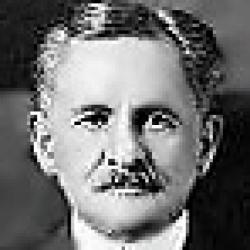
Edwin Hall
 USA
USA- Edwin Hall: The Pioneer of the Hall Effect
- Early Life and Education
- Research at Johns Hopkins
- Discovery of the Hall Effect
- Significance of the Hall Effect
- Publication and Legacy
Edwin Hall: The Pioneer of the Hall Effect
Edwin Hall was an American physicist renowned for his discovery of the Hall effect, a fundamental phenomenon in physics and engineering.
Early Life and Education
Born in Gorham, Maine, Edwin Hall pursued his undergraduate studies at Bowdoin College in Brunswick, graduating in 1875. He furthered his education at Johns Hopkins University, where he earned his doctorate in 1880.
Research at Johns Hopkins
Hall's doctoral research focused on thermoelectric investigations at Harvard University. During his experiments at Johns Hopkins, he made his groundbreaking discovery in 1879.
Discovery of the Hall Effect
While experimenting with a gold plate mounted on glass, Hall observed a potential difference across the lateral edges of the plate when subjected to a magnetic field perpendicular to its plane. This phenomenon, later known as the Hall effect, was crucial in understanding the behavior of materials in magnetic fields.
Significance of the Hall Effect
The Hall effect paved the way for numerous advancements in physics and technology. The "Hall resistance," defined as the ratio of Hall voltage to longitudinal current, became a key characteristic for analyzing the properties of materials used in Hall elements.
Publication and Legacy
Hall's doctoral thesis, published in 1880, showcased his groundbreaking research and earned him recognition in the scientific community. The Hall effect continues to be a fundamental concept in physics and is widely applied in various fields, including electronics, materials science, and medical imaging.