Diades Pella
 Greece
- Diades the Engineer
- Apprenticeship and Campaigns
- Treatise on Siegecraft
- Tortoises and Siege Towers
- Siege of Tyre and Helepolis Towers
- Description of Helepolis Towers
- Legacy
Diades the Engineer
Diades was an ancient Greek engineer specializing in military engineering who lived in the 4th century BC.
Apprenticeship and Campaigns
As a student of Polyides the Thessalian and military engineer under Philip II of Macedon, Diades accompanied Alexander the Great in his eastern campaigns alongside another student, Charias. Diades' role involved leading sieges such as that of Tyre, where he employed innovative or improved military mechanisms.
Treatise on Siegecraft
Diades authored the first known treatise on siegecraft, which is now lost. In his mechanical writings, he claimed to have invented several devices, including mobile towers, siege towers known as "tortoises," a wall-boring device, and a drawbridge.
Tortoises and Siege Towers
Diades employed "tortoises" equipped with battering rams on wheels. The largest of these measured 13.31 meters wide, 17.74 meters long, and 5.77 meters high. When a ridge was added to the roof, the height reached 7.10 meters. The wall-boring device was housed within a "tortoise" approximately 22 meters long, while the borer itself was a long beam tipped with iron that moved along a wooden trough using a winch and blocks. The borer had a length of 25 meters.
Siege of Tyre and Helepolis Towers
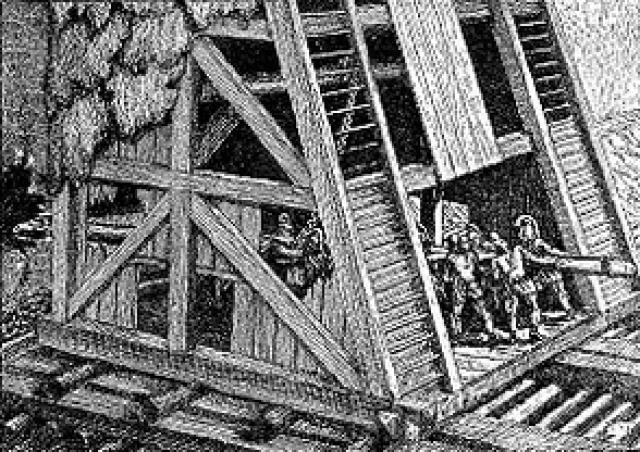
Diades' construction of the giant Helepolis towers during the siege of Tyre is well-documented. The walls of Tyre stood 44.4 meters above sea level. The city was located on an island separated from the mainland by a strait 800 meters wide and up to 5.5 meters deep. Despite these obstacles, Alexander constructed a 60-meter wide causeway and employed two eight-wheeled, twenty-story Helepolis towers to reach the city walls. These colossal structures had a height of 53 meters, requiring guy ropes to prevent wind damage.
Description of Helepolis Towers
According to Plutarch, the Helepolis towers were both awe-inspiring and terrifying, measuring approximately 53.2 meters in height, 13.3 meters in maximum width, and 6.66 meters in minimum width. Diodorus provided a detailed description of a similar Helepolis tower constructed by Demetrius for the siege of Salamis, with dimensions of 45 meters in length and 90 meters in height, divided into nine stories and supported by four 8-meter tall wheels.
Legacy
Diades' work was later cited by mechanical engineers such as Athenaeus Mechanicus and Vitruvius, establishing his influence on the field of siege engineering.