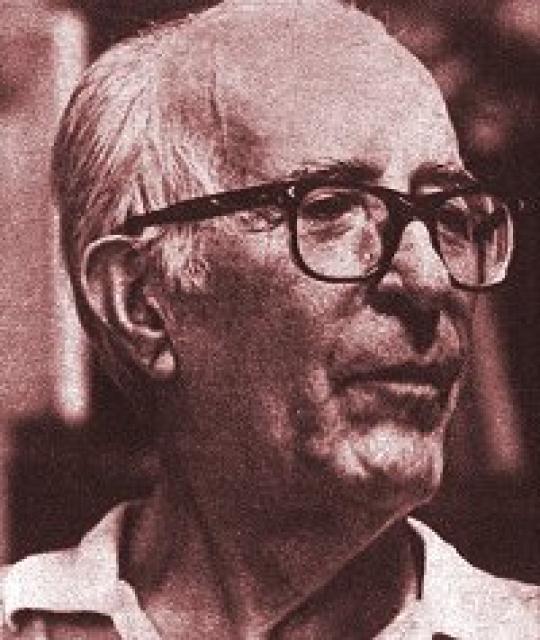
Diego Abad de Santillan
 Spain
Spain- Biography of Diego Abad de Santillán
- Early Activism and Imprisonment
- Travel to Mexico and Return to Argentina
- Anarchist Activism in Spain
- Minister of Economy and Later Years
Biography of Diego Abad de Santillán
Diego Abad de Santillán, born as Sinesio Baudilio García Fernández on May 20, 1897, in Reyero, León, Spain, was an author, economist, and one of the leaders of the Spanish and Argentine anarchist movements. At the age of 8, he emigrated to Argentina with his parents. Santillán attended evening school from the age of 10, as he had to work during the day. He held various jobs, including working on the railway. In 1912, Diego arrived in Spain and enrolled in the University of Madrid in 1915 after completing his bachelor's degree.
Early Activism and Imprisonment
In 1917, after a general strike, Santillán was imprisoned in Madrid, where he encountered anarchism for the first time through the influence of Tomás Herreros. He was released on amnesty in 1918 and returned to Argentina, becoming an activist for the Argentine Regional Workers' Federation (Federación Obrera Regional Argentina, or FORA). He was appointed editor of the newspaper 'La Protesta' (The Protest), which was published weekly by FORA. In 1922, Diego became a representative of FORA at the International Workers' Association in Berlin (IWMA). During this time, he also began studying medicine and met his future wife, Elise Kater. He published his first works on the history and theory of anarchism, including 'Ricardo Flores Magón: Apostle of the Mexican Social Revolution' and 'Anarchism in the Labour Movement,' both in 1925.
Travel to Mexico and Return to Argentina
In 1926, Santillán interrupted his studies to travel to Mexico, where he assisted the General Confederation of Labor (CGT). Upon returning to Argentina, he resumed his role as editor of 'La Protesta' and began editing the journal 'La Antorcha' (The Torch). His book 'The Anarchist Movement in Argentina: From Its Beginnings to 1910' was completed and published in 1930. In the late 1920s, he actively opposed Severino Di Giovanni, an anarchist whose tactic of propagating through actions resulted in the deaths of several people. In 1930, Diego, sentenced to death for his involvement in a rebellion, managed to escape to Uruguay and eventually made his way back to Spain. He secretly returned to Argentina and continued writing several books, including 'The Bankruptcy of the Capitalist Economic and Political System' and 'Social Reconstruction: Foundations for a New Economic Structure in Argentina.'
Anarchist Activism in Spain
In late 1933, Santillán arrived in Barcelona, Spain. Over the following years, Diego became a member of the Iberian Anarchist Federation (FAI), serving as its secretary for the Pyrenees Peninsula region in 1935. He was also the editor of the daily publications 'Solidaridad Obrera' (Workers' Solidarity) and 'Tierra y Libertad' (Land and Freedom), and was a founding member of the journals 'Tiempos Nuevos,' 'Butlletí de la Conselleria d'Economia,' and 'Timón.' Reflecting on the economic theory of anarchism, Santillán wrote 'The Economic Organism of the Revolution' in 1936.
Minister of Economy and Later Years
From December 1936 to April 1937, Santillán served as the Minister of Economy (Conseller de Economía) in the Catalan government, during which time he heavily criticized the Spanish Republic and Juan Negrín. During this period, Santillán wrote 'The Revolution and the War in Spain' and a bibliography of Argentine anarchist works. In the spring of 1938, he became a member of the National Committee of the Anti-Fascist Popular Front, formed through the alliance of the FAI and socialist groups. In 1939, following the defeat of the Republic by Francisco Franco's forces, Diego was forced to return to Argentina via France.
Santillán contributed to the creation of the 'Gran Enciclopedia Argentina' (Great Argentine Encyclopedia) and wrote books such as 'Why We Lost the War: A Contribution to the History of the Spanish Tragedy.' In 1977, at the age of 80, he returned to Spain, settled in Barcelona, and wrote his final book, 'Memorias 1897-1936' (Memoirs 1897-1936). Diego Abad de Santillán passed away on October 18, 1983, in Barcelona.


