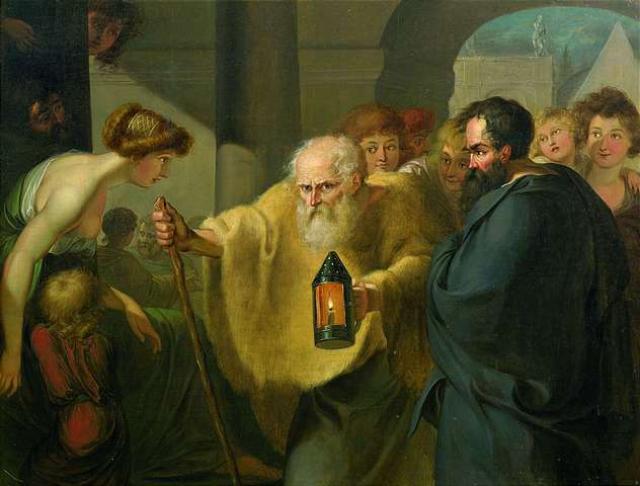
Diogenes
 Greece
- Early Life and Education
- Controversial Lifestyle and Sparring with Plato
- Enslavement and Teachings
- Legacy and Philosophical Views
Early Life and Education
Diogenes the Cynic, a renowned ancient Greek philosopher, was a disciple of Antisthenes, the founder of the Cynic school. According to Diogenes Laertius, a popular source of anecdotes about ancient Greek philosophers, Diogenes' father was Hicesius, a money exchanger. Upon visiting the Oracle of Delphi, he was instructed to "revalue currency." Initially interpreting this as "coinage," he later realized his calling in philosophy upon his exile. In Athens, he joined Antisthenes, setting up residence in a large clay vessel, or pithos, near the agora.
Controversial Lifestyle and Sparring with Plato
Diogenes' eccentric lifestyle often sparked controversy. He ate meals in public, an unusual practice at the time, and openly engaged in self-gratification, claiming, "If only hunger could be satisfied by rubbing the belly!" On one occasion, he trampled on Plato's carpet, exclaiming, "I trample on Plato's pride." In response to Plato's definition of man as "a featherless biped," Diogenes plucked a chicken and declared it a Platonic man. Plato, in turn, referred to Diogenes as "Socrates gone mad." Diogenes rejected Plato's theory of Forms, famously stating, "I see a bowl, not bowleness."
Enslavement and Teachings
During the Battle of Chaeronea, Diogenes was captured by the Macedonians and sold as a slave. At the slave market, he replied to the question of his skills that he could "rule over men." He was purchased by Xeniades, who sought him as a tutor for his children. Diogenes taught them horsemanship, javelin throwing, history, and Greek poetry. Upon his death, he requested to be buried face down.
Legacy and Philosophical Views
Diogenes challenged societal norms and mocked religious ceremonies. He despised demagogues and politicians, considering them flatterers of the masses. Proclaiming himself a citizen of the world, he argued for the relativity of morality. Diogenes died on the same day as Alexander the Great, according to Diogenes Laertius. A marble monument in the form of a dog was erected on his grave, bearing an epitaph that praised his teachings on contentment and simplicity.
Despite the scarcity of written works attributed to Diogenes, his philosophical views are evident in the extensive doxographies of Cynic philosophers. He advocated for asceticism, exemplified by the self-sufficient mouse. Diogenes' residence in a clay jar and his minimalist possessions illustrated this principle. His only belongings were a wallet and a staff. He was often seen walking barefoot in the snow. When Alexander the Great offered him a favor, Diogenes merely requested that he step out of his sunlight. Asceticism, he believed, brought about true happiness through freedom and independence.


