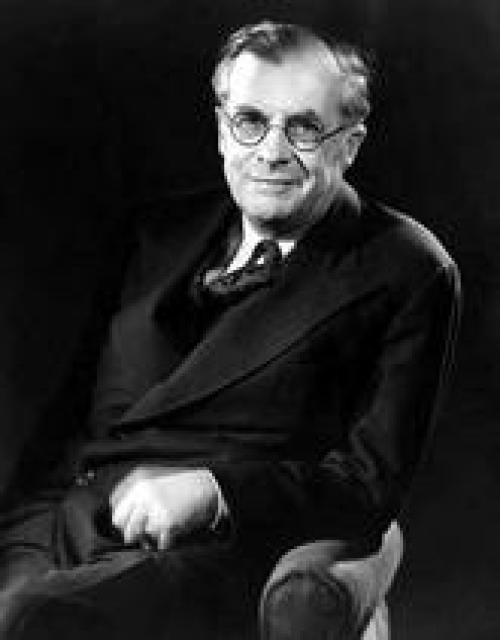
Djulian Huxley
 Great Britain
- Biography of Julian Huxley
- Early Career
- Academic Career
- Later Career and Achievements
- Notable Works
- Death
Biography of Julian Huxley
Julian Huxley was an English biologist and philosopher born on June 22, 1887, in London. He was the grandson of Thomas Huxley and the grandnephew of Matthew Arnold, as well as the eldest son of historian Leonard Huxley and brother of writer Aldous Huxley. He received his education at Eton College and Balliol College, Oxford University.
Early Career
In 1910-1912, Huxley gave lectures on zoology at Balliol College. His first book, "The Individual in the Animal Kingdom," was published in 1912. He worked as a research fellow at the Rice Institute in Houston, Texas, and returned to England in 1916. During World War I, he served in Italy at the General Staff.
Academic Career
From 1919 to 1925, Huxley taught at New College and was the senior demonstrator in zoology at Oxford University. He was also part of the university expedition to Spitsbergen in 1921. During this period, he wrote a series of articles titled "America Revisited" and published his first popular science work, "Essays of a Biologist," in 1923. From 1925 to 1927, Huxley was a professor of zoology at King's College, London. He was the president of the National Union of Scientific Workers and the Royal Association from 1926 to 1929.
Later Career and Achievements
Huxley's visits to Africa and the Soviet Union resulted in the books "Africa View" (1931) and "A Scientist Among the Soviets" (1932). In 1935, he became the secretary of the London Zoological Society and served as the director of the London Zoo until 1942. During World War II, he organized a series of sessions for the British Association for the Advancement of Science. He worked as the executive secretary of the preparatory commission for UNESCO and was elected as its director-general in December 1946. In 1956, Huxley delivered lectures at McGill University in Canada and received the Darwin Medal from the Royal Society. He was knighted in 1958.
Notable Works
Huxley's notable works include "The Stream of Life" (1926), "The Science of Life" (co-authored with G.G. and G.P. Wells, 1929), "What Dare I Think" (1931), "Captive Shrew and Other Poems of a Biologist" (1932), "Evolution, the Modern Synthesis" (1942), "Man in the Modern World" (1947), "Heredity, East and West" (1949), "Evolution in Action" (1953), "From an Antique Land" (1954), "Kingdom of the Beasts" (co-authored with W. Sutchinsky, 1956), "Religion Without Revelation" (1957), "Secrets of Life" (1957), "Biological Aspects of Cancer" (1957), "New Wine in New Bottles" (1957), "Human Crisis" (1963), "Essays of a Humanist" (1964), "Aldous Huxley, 1894-1963" (1966), "Courtship Habits of the Great Crested Grebe" (1968), and "Memories" (1970).


