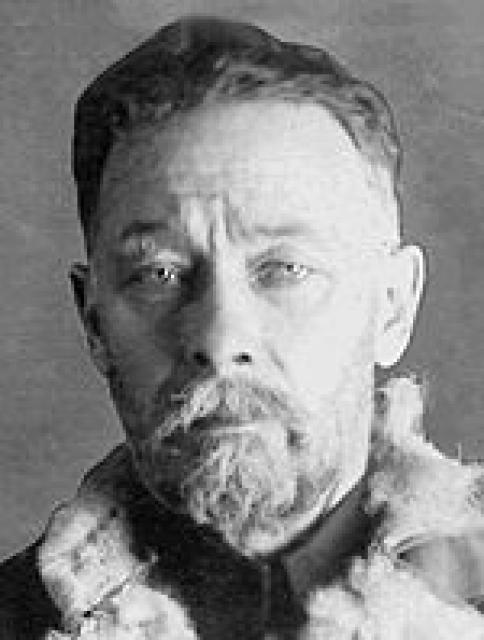
Dmitriy Shepkin
- Early Life and Education
- Civil Service and Political Involvement
- All-Russian Zemstvo Union
- Provisional Government and Beyond
Early Life and Education
Dmitry Mitrofanovich Shchepkin was born on January 10, 1879, into a prominent Moscow intelligentsia family. His father, Mikhail Petrovich Shchepkin, was an influential figure in Moscow's municipal government.
Shchepkin graduated from the law faculty of Moscow University in 1902. He went on to publish several academic works on history.
Civil Service and Political Involvement
From 1903 onwards, Shchepkin worked in various Moscow government offices. In 1906, he became a supernumerary official under the Moscow governor. He briefly served as assistant to the Duma bailiff in 1907 before being dismissed after the Duma's dissolution.
In February 1907, Shchepkin joined the State Chancellery, where he was again assigned to the Duma Chancellery. In August 1908, he became a staff member of the Duma, serving as a clerk. He often acted as secretary to the Duma's chairman.
From 1911, Shchepkin was the senior clerk of the General Assembly and General Affairs Department, heading its fourth division. In 1913, he attained the rank of Collegiate Councilor.
All-Russian Zemstvo Union
After the formation of the All-Russian Zemstvo Union in July 1914, Shchepkin participated in organizing the union's Moscow office. While remaining an employee of the Duma, he was elected to the Union's Main Committee in December 1914 and became a close associate of its leader, Prince Georgy Lvov.
Provisional Government and Beyond
On March 2, 1917, Shchepkin was appointed Deputy Interior Minister in the Provisional Government, a post he held until August 2, 1917. He later chaired the Council of Public Figures.
During the Russian Civil War, Shchepkin was involved in anti-Bolshevik organizations in Moscow. In 1920, he was sentenced to 10 years' imprisonment but later released under an amnesty. He was arrested again in 1922, but after his release, he worked for the Moscow syndicate "Selmash."


