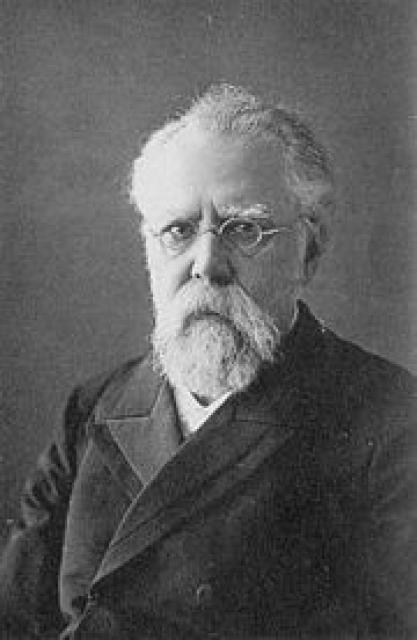
Dmitriy Zernov
- Dmitri Nikolaevich Zernov: A Distinguished Academic Career
- Medical Career and Research
- Academic Rise at Moscow University
- Rectorship and Further Contributions
- Publications and Scientific Work
- Legacy and Impact
Dmitri Nikolaevich Zernov: A Distinguished Academic Career
Early Life and EducationDmitri Nikolaevich Zernov was born in Moscow, Russia, into a prominent academic family. His father, Nikolai Evgenievich Zernov, was a professor of mathematics at Moscow University. After receiving his early education at home, Zernov enrolled in the medical faculty of Moscow University in 1859.
Medical Career and Research
Upon graduating in 1865, Zernov worked as an intern in an eye clinic and later defended his doctoral dissertation on the microscopic structure of the human and vertebrate lens. He became a supernumerary assistant in histology at Moscow University under the guidance of his teacher, A. I. Babukhin. In 1868, he traveled abroad with Babukhin, primarily to Trieste, to enhance his knowledge of histology.
Academic Rise at Moscow University
In 1869, Zernov was appointed associate professor of anatomy at Moscow University. He continued his education through study abroad, visiting renowned anatomical institutes in Europe. In 1873, he became an extraordinary professor, and in 1875, an ordinary professor of anatomy. He was named an emeritus professor in 1894.
Rectorship and Further Contributions
In 1898/1899, Zernov served as the rector of Moscow University. After leaving the post of rector, he continued his academic work at the university and as a lecturer at the Higher Women's Courses, where he became a professor in 1909. He was also involved in university governance, serving as a judge in the professorial disciplinary court from 1902 onward and as dean of the medical faculty from 1906 to 1913.
Publications and Scientific Work
Zernov made significant contributions to medical literature, publishing works on hermaphroditism, brain convolutions, and anatomical characteristics of intelligent individuals. His most notable work was the "Textbook of Human Descriptive Anatomy" (1890-1892), which became a widely used textbook for generations of Russian physicians.
Legacy and Impact
Zernov's contributions went beyond his publications. He played a key role in the construction of the anatomical theater at Moscow University in 1876 and the development of an encephalometer in 1889. Zernov's son, Vladimir Dmitrievich Zernov, became a distinguished professor of physical-mathematical sciences and one of the founding professors of Saratov University.