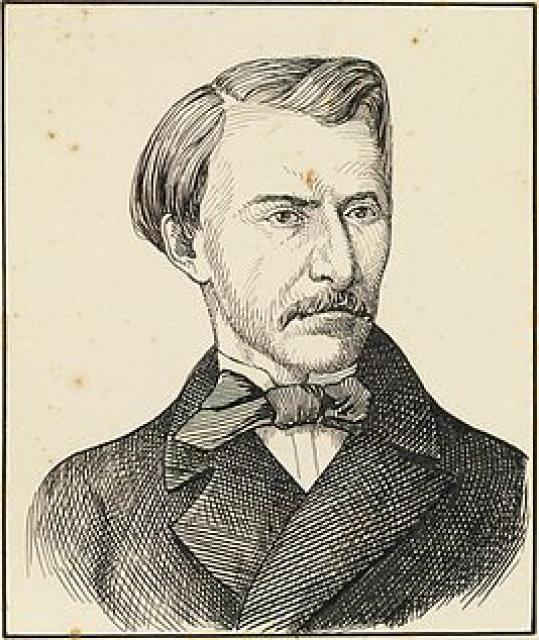
Domingos Jose Goncalves de Magalhaes
 Brazil
- Visconde de Araguaia: A Literary and Intellectual Pioneer
- Literary Career
- Philosophical Musings and Love Songs
- Literary Activism and Romantic Manifesto
- Dramatic Works and Epic Poem
- Historical and Philosophical Writings
- Final Years and Legacy
Visconde de Araguaia: A Literary and Intellectual Pioneer
Early Life and EducationManuel de Araújo Porto-Alegre, known by the title Visconde de Araguaia, was born in Rio Grande do Sul, Brazil, on November 29, 1806. He received a multifaceted education, studying medicine, law, and philosophy in both Brazil and Europe.
Literary Career
Poetic Debut and Romantic InfluenceAraguaia's literary debut came with the publication of his "Poesias" in 1832. This collection showcased his adherence to neoclassicism. However, his subsequent work, "Suspiros e Saudades" (1835), marked a turning point, introducing a new romantic sensibility into Brazilian poetry.
Philosophical Musings and Love Songs
Araguaia's philosophical reflections found expression in his renowned "Myst?rios." His collection "Ur?nia" (1832) featured love songs, further expanding his poetic repertoire.
Literary Activism and Romantic Manifesto
As the editor of the journal "Niter?i," Araguaia championed the cause of romanticism. His preface to Gonçalvis's "Poesias" (1836) served as a manifesto for the Brazilian Romantic movement, shaping its aesthetic ideals.
Dramatic Works and Epic Poem
In addition to his poetry, Araguaia wrote several tragedies, including "Ant?nio José" (1839) and "Olgiato" (1839), the first of their kind in Brazilian literature. His most celebrated work was the epic poem "A Confedera??o dos Tamoyos" (1856), which celebrated the struggles of indigenous tribes against Portuguese colonizers.
Historical and Philosophical Writings
Beyond his literary endeavors, Araguaia penned historical works, such as "Ensaio sobre a hist?ria litter?ria do Brazil" (1834). His "Factos do esp?rito humano" (1858) and "Myst?rios e e cantos fúnebres" (1858) demonstrated the influence of spiritualism on his thinking.
Final Years and Legacy
Visconde de Araguaia passed away in Rio de Janeiro on December 4, 1879. His literary and intellectual contributions to Brazilian culture left an enduring mark, earning him a place among the pioneers of Brazilian literature. A collection of his complete works, "Obras completas," was published in nine volumes from 1864 to 1876.