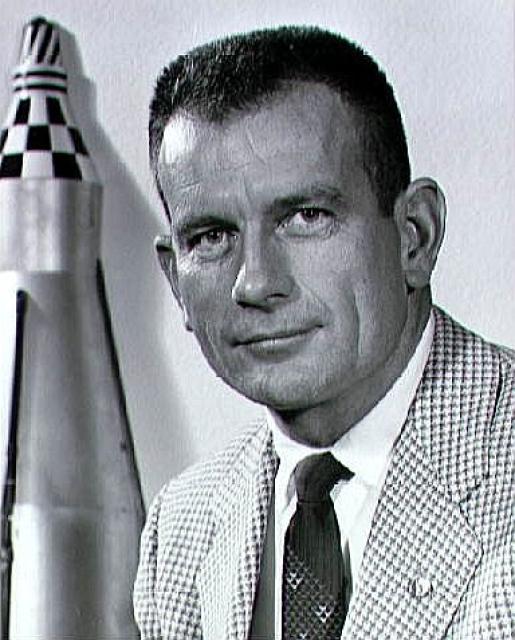
Donald Kent Slayton
 USA
USA- Early Life and Military Service
- NASA Career and Astronaut Selection
- Medical Disqualification and Administrative Roles
- Return to Flight and Apollo-Soyuz Mission
- Later Career and Legacy
Early Life and Military Service
Donald Kent "Deke" Slayton was born on March 1, 1924, in Sparta, Wisconsin. On his 18th birthday, he enlisted in the U.S. Army Air Forces and began pilot training. He became a pilot in April 1943 and was assigned to the European front. Slayton flew 56 combat missions as a B-25 bomber pilot from 1943 to 1944. He returned to the U.S. in mid-1944 and served as a flight instructor. In April 1945, he was deployed to Okinawa, Japan, where he participated in combat operations.
After World War II, Slayton continued as a flight instructor. In 1946, he left the military and enrolled at the University of Minnesota. He graduated with a Bachelor of Science degree in Aeronautical Engineering in 1949 and joined The Boeing Company in Seattle.
NASA Career and Astronaut Selection
In 1951, Slayton joined the Minnesota Air National Guard. He served in Germany at Bitburg Air Base and eventually became a fighter squadron commander. On May 15, 1955, he married Marjorie Lunney. Slayton returned to the U.S. in June 1955 and began serving at Edwards Air Force Base in California. From January 1956 to April 1959, he worked as a test pilot.
On April 9, 1959, Slayton was selected as one of the original "Mercury Seven" astronauts. He was initially scheduled to make the fourth suborbital flight on the Mercury-Redstone 6 mission in fall 1961. However, after the successful orbital flights of Soviet cosmonauts Yuri Gagarin and Gherman Titov, the number of planned suborbital flights was reduced to three.
Medical Disqualification and Administrative Roles
Slayton was then slated to make the first American orbital flight. However, NASA decided to cancel the third planned suborbital flight, which was to be flown by John Glenn. Instead, Glenn was assigned to the Mercury-Atlas 6 mission, while Slayton was chosen to command the Mercury-Atlas 7 mission.
On March 15, 1962, Slayton was medically disqualified from spaceflight due to a heart murmur. Scott Carpenter replaced him on the Mercury-Atlas 7 mission, which was renamed Aurora 7. Slayton remained in NASA, working in administrative roles. He became Chief of the Astronaut Office for the Mercury, Gemini, and Apollo programs. In 1963, he retired from the Air Force but continued at NASA as Deputy Director for Flight Crew Operations.
Return to Flight and Apollo-Soyuz Mission
In 1969, Slayton received NASA's Distinguished Service Medal. He never gave up hope of flying in space. In 1970, his heart murmur was determined to have resolved. After a thorough medical evaluation, he was reinstated as an astronaut in March 1972.
On February 9, 1973, Slayton was assigned to the crew of the Apollo spacecraft for the joint Soviet-American Apollo-Soyuz Test Project. He was 51 years old at the time, making him the oldest astronaut to fly in space. On July 15, 1975, the Apollo command module docked with the Soviet Soyuz 19 spacecraft in orbit. Slayton became the last of the original "Mercury Seven" astronauts to make a spaceflight.
Later Career and Legacy
After December 1975, Slayton led the testing of the Space Shuttle Enterprise in California. From November 1977 to February 1982, he served as Manager of Space Shuttle Flight Operations and Planning. In 1982, Slayton left NASA and became President of Space Services Inc., a private company that designed rockets for small payloads.
Donald Slayton died on June 13, 1993, at the age of 69 from a brain tumor. He is remembered as a pioneer in the U.S. space program and an inspiration for aspiring astronauts.


