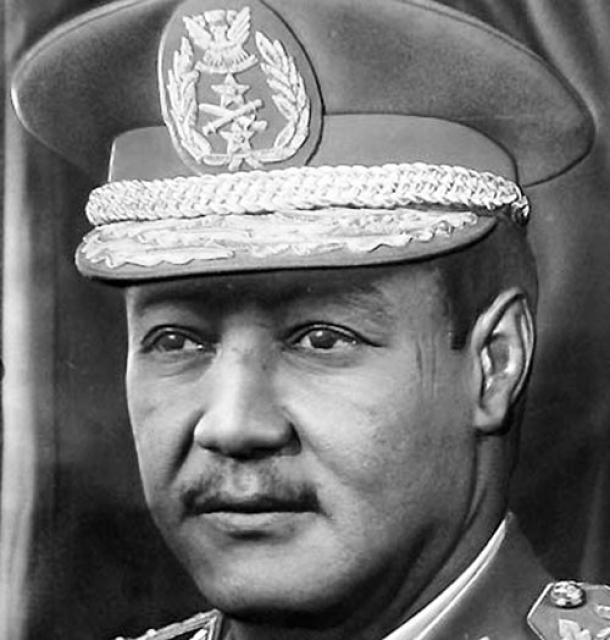
Dzhafar Nimeyri
 Sudan
Early Life and Military Career
Gaafar Muhammad al-Nimeiri was born into a middle-class family in Sudan. In 1952, he graduated from the Sudanese Military College before pursuing further military training in Germany and the United States, earning a master's degree in Military Sciences.
Nimeiri emerged as a prominent figure in the underground military organization known as the "Free Officers," established around 1964. This group aimed to overthrow the existing Sudanese government.
Rise to Power
On May 25, 1969, Nimeiri led a group of officers in a military coup that toppled the government. He subsequently assumed the roles of Chairman of the Revolutionary Council, Prime Minister, and Commander-in-Chief of the Armed Forces.
In 1971, Nimeiri was briefly removed from power due to an attempted communist coup. However, he regained control shortly after and went on to serve as President of the Democratic Republic of Sudan (DRS), Prime Minister, and Chairman and General Secretary of the Sudanese Socialist Union.
Influence of Islam
The growing influence of Islam in Sudan in the 1970s and 1980s had a profound impact on Nimeiri's policies. Initially, he had aligned with the Sudanese Communist Party and promoted a secular concept of "Arab Socialism." However, under pressure from anti-Marxist forces, he shifted his stance.
On September 8, 1983, Nimeiri declared Sudan an Islamic republic and implemented Sharia law. He introduced Muslim laws, courts, and punishments, emphasizing his own piety and involvement with Sufi brotherhoods. He also incorporated members of the Muslim Brotherhood into his government.
Overthrow and Legacy
Nimeiri's radicalization of Islamic practices and policies sparked widespread opposition. In April 1985, while on an official visit to the United States, he was overthrown in a bloodless military coup led by political opponents who rejected his attempts at total Islamization.