Edgar Degas
 France
Biography of Edgar Degas
Edgar Degas was a French painter, printmaker, and sculptor. He was born on July 19, 1834, into a wealthy family that belonged to the higher echelons of French society and had close ties to Italy and the United States. After completing his studies at the Lycee Louis-le-Grand, Degas initially intended to study law. However, in 1855, he enrolled in the School of Fine Arts, studying under Louis Lamothe, who adhered to the classical direction in the visual arts.
Early in his artistic career, Degas seemed to be inclined towards working within the framework of classical realism. He began copying the works of Andre Montenay, Sandro Botticelli, and Nicolas Poussin, all known for their meticulous rendering of depicted objects. By 1860, Degas had created several remarkable portraits in the finest classical traditions, including the "Portrait of Countess Morbilli". In 1860, he first employed a classical ancient theme in his artwork with "Young Spartan Exercising". In 1861, Degas painted "Semiramis Finding Babylon". After this painting, he decided to no longer use academic subjects and embarked on a search for his own style, drawing inspiration from Paris (possibly influenced by Manet).
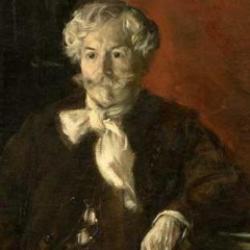
From 1862, Degas began to depict horses, horse racing, and jockeys. Individual musicians and entire orchestras during performances later became his subjects of interest. Degas was particularly fascinated with capturing the quality of execution in his paintings and the precise rendering of bodily movements. The portraits of Edgar Degas from the 1870s are incomparably more professional and realistic, showcasing the artist's distinctive touch.
During the Franco-German War of 1870-1871, Degas served in the artillery. Upon his return, he continued to develop his mastery of depicting objects in motion. In October 1872, Degas traveled to the United States, where he stayed for five months and created one of his finest works, "New Orleans Cotton Office" (1873). In 1884, another famous work, "The Ironing Women," was produced. It was during this period that Degas began extensively using pastels in his artwork.
In 1880, Degas ventured into sculpture, transferring his talent for capturing bodies in motion to ballerinas and horses. Another aspect of Degas' artistic expression was photography. Living at a time when the photographic medium was just emerging, the artist had ample opportunities to experiment in this new field. In his later years, Degas began to lose his eyesight, initially in one eye and later in both. The great artist passed away on September 2, 1917.