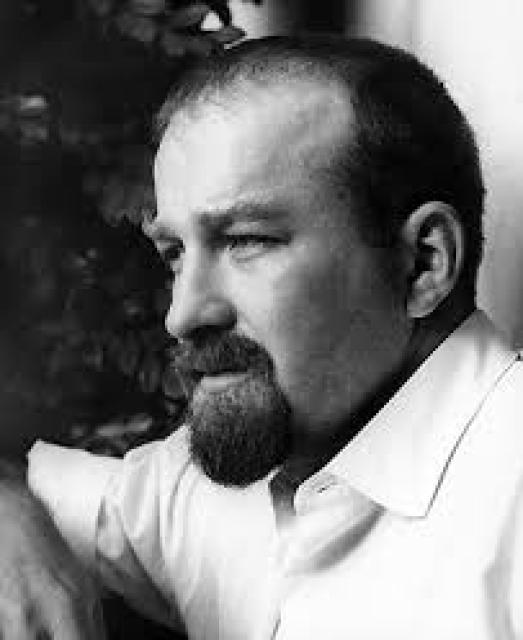
Edward Kienholz
 USA
USABiography of Edward Kienholz
Edward Kienholz was an American artist who worked primarily in the field of installation art. Born in Fairfield, Washington, he grew up in a farming family. Despite not receiving formal artistic training, Kienholz moved to Los Angeles in 1953 and became a co-founder of the avant-garde gallery "Now" in 1956, followed by the "Ferus" gallery in 1957.
Kienholz initially created painted wooden reliefs, which were reminiscent of the spirit of pop art. His first solo exhibition took place in 1956 at Syndell Studio in Los Angeles, California. By the late 1950s, he transitioned to creating compositions in the technique of spatial environment. Three-dimensional object scenarios became the focal point of his work, completely occupying entire interiors.
Using mannequins, dolls, and real objects, Kienholz constructed "living paintings" immersed in an atmosphere of gloomy melancholy and decay. He incorporated audio effects and even programmed scents to enhance the viewer's experience.
Since the 1970s, Kienholz collaborated with his wife, artist Nancy Reddin Kienholz (born 1943). In their grotesque and surrealistic combinations of objects and mannequins, they created frozen scenes reminiscent of a satirical spectacle. One of their notable installations, "Roxie" (1961) and "The Beanery" (1962), were presented at the London National Gallery.
In 2009, the Kienholz couple's installation titled "The Red Light District" was exhibited, meticulously reproducing the famous Amsterdam red-light district. This work was originally created in the 1980s. Visitors entered a dimly lit room depicting a street with bicycles, while houses and storefront windows were illuminated with red lamps. Through the windows, partially clothed female mannequins could be seen smoking, reading, and simply waiting for clients, just like in Amsterdam. The heads of the women were displayed in transparent boxes, symbolizing the separation of their souls from their bodies, which were being sold.
Throughout his career, Kienholz created numerous works, including "John Doe" (1959), "The Portable War Memorial" (1962), "Unlawful Operations" (1962), "The State Hospital" (1964-1966), "Wait" (1964-1965), "Back Seat Dodge '38" (1964), "The Birthday" (1964), "The Cheap Little Restaurant of Barney" (1965), "Sollie 17" (1979-1980), "The Mourning of the Death of a Horse" (1989), "The Pool Hall" (1993), and many more.
Edward Kienholz passed away from a heart attack in Hope, Idaho. In 1996, a retrospective exhibition of his works was held at the Whitney Museum of American Art in New York.



