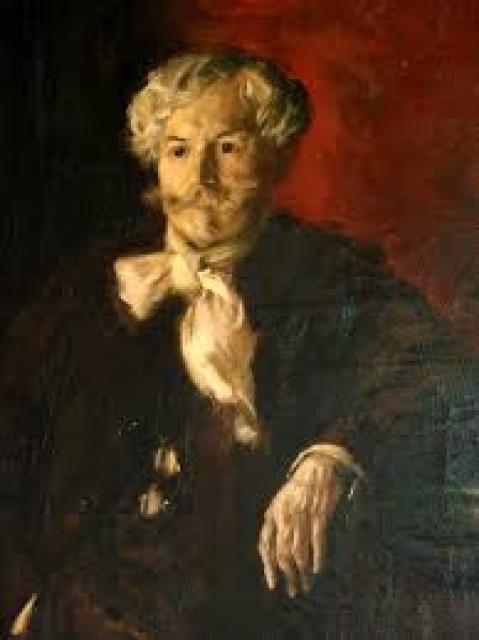
Edmon Goncourt
 France
- Biography of Edmond de Goncourt
- Early Life and Career
- Literary Achievements
- Writing Style and Themes
- Later Years and Legacy
Biography of Edmond de Goncourt
Edmond Louis Antoine de Goncourt, along with his brother Jules Alfred Huot, were French writers who formed one of the most remarkable creative partnerships in literary history. They gained fame as novelists, historians, art critics, and memoirists. Their name was bestowed upon the Academy and the prize, which was founded by the elder of the two brothers.
Early Life and Career
Edmond and Jules de Goncourt lost their father in 1834 and their mother in 1848, leaving them with a substantial inheritance that allowed them to dedicate themselves to literature, history, and art. Initially, they attempted to pursue careers as artists or playwrights, but all their endeavors in painting or on stage ended in failure. Their first novel, "En 18.." published in 1851 on the day of Louis Napoleon's coup, also met with little success in literary criticism.
Literary Achievements
Though lacking a keen sense of contemporary tastes in artistic criticism, the brothers were able to restore the reputation of A. Watteau, O. Fragonard, F. Boucher, and other French artists of the previous century in their seminal work "L'Art du dix-huitime sicle" (The Art of the Eighteenth Century, 1859-1875). In the field of history, they showed an interest in the same era, focusing not so much on its political aspects but on its social aspects. They skillfully used ordinary documents such as theater programs, clothing patterns, and restaurant menus in their works "Histoire de la Socit francaise pendant la Rvolution" (History of French Society during the Revolution, 1854) and "Portraits intimes du dix-huitime siecle" (Intimate Portraits of the Eighteenth Century, 1857-1858).
Writing Style and Themes
Believing that "the foundation of a novel should be life itself," the Goncourt brothers often drew their plots and characters from their own surroundings. For example, in the book "Charles Demailly" (1860), they portrayed a familiar married couple. "Soeur Philomene" (1861) tells the story of an event that took place in a hospital in Rouen, which they came to know through a friend's account. The protagonist of "Rene Mauperin" (1864) was a childhood friend of theirs. "Germinie Lacerteux" (1864), the first great French novel about lower-class life, foreshadowing Emile Zola's proletarian novels, depicted the dissolute life once led by the Goncourts' housekeeper. "Manette Salomon" (1867) focused on artists and models whom they personally knew, while "Madame Gervaisais" (1869) narrated the conversion, religious fanaticism, and death of their aunt.
Later Years and Legacy
After Jules' death, Edmond took a break from writing for several years before returning to novels with "La Fille Elisa" (1875), a book about a prostitute. This was followed by "Les Frres Zemganno" (1879), the story of two circus acrobats who closely resemble the Goncourts themselves, and "La Faustin" (1882), based on the life of actress Rachel (1821-1858).
In his later years, Edmond de Goncourt focused on the works of Japanese artists, publishing books on Utamaro (1891) and Hokusai (1896). He also made additions to the "Journal des Goncours" (Goncourt's Journal, 1887-1896), one of the most famous chronicles of literary life, which the brothers started in 1851 and Edmond continued until his death.


