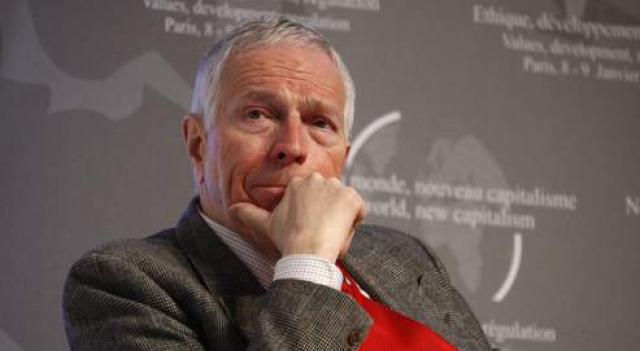
Edmund Phelps
 USA
USA- Biography of Edmund Phelps
- Education and Early Career
- Contributions to Economic Research
- Later Career and Contributions
Biography of Edmund Phelps
Edmund Phelps, an American economist, is a Nobel laureate known for his contributions to the study of unemployment and macroeconomics. He was born in Evanston, Illinois and later moved with his family to Hastings-on-Hudson, New York.
Education and Early Career
Phelps attended Amherst College starting in 1951 and became interested in economics after taking a course taught by James Nelson. He continued his studies at Yale, where he was taught by future Nobel laureates James Tobin and Thomas Schelling. In 1959, he successfully defended his doctoral dissertation. Before completing his degree, Phelps worked as an economist at RAND Corporation, but ultimately decided to pursue a career in academia.
Contributions to Economic Research
In 1960, Phelps joined the Cowles Foundation and also taught at Yale. During his time at the foundation, he focused on studying neoclassical growth theory and published a notable article on the "golden rule" of savings. He also conducted research on monetarism, Ricardian equivalence, and optimal growth. Phelps had the opportunity to collaborate with renowned economists such as Arthur Okun, Tjalling Koopmans, and David Cass.
In 1966, Phelps left Yale and accepted a permanent position as a professor at the University of Pennsylvania. Here, he shifted his research interests to the relationship between wage levels, unemployment, and inflation. His studies in this area led to the publication of the influential article "Money-Wage Dynamics and Labor Market Equilibrium" in 1968, which contained important microeconomic insights.
In 1971, Phelps joined Columbia University, where he collaborated with economists such as William Vickrey, James J. Heckman, Guillermo Calvo, and John B. Taylor. During the 1980s, Phelps began to actively collaborate with European educational and financial institutions, particularly the Bank of Italy. He became deeply interested in the persistently high inflation levels in Europe and developed a theory that explained this as a constant and stable equilibrium disruption.
Later Career and Contributions
In the following years, Phelps focused on developing a comprehensive theory for determining the natural rate of unemployment. A partial version of this theory was published in his book "Structural Slumps: The Modern Equilibrium Theory of Employment, Interest, and Assets" in 1994.
In 1990, Phelps joined the "Moscow" project of the European Bank for Reconstruction and Development, where he worked alongside Kenneth Arrow on a proposal for reforming the USSR. He later joined the Economic Advisory Council and remained a member until 1993. Phelps then turned his attention to studying the transitional economies of Eastern Europe, using his observations to enhance his non-monetary theory of unemployment and labor market dynamics, which also explained the situation in Europe as a whole.