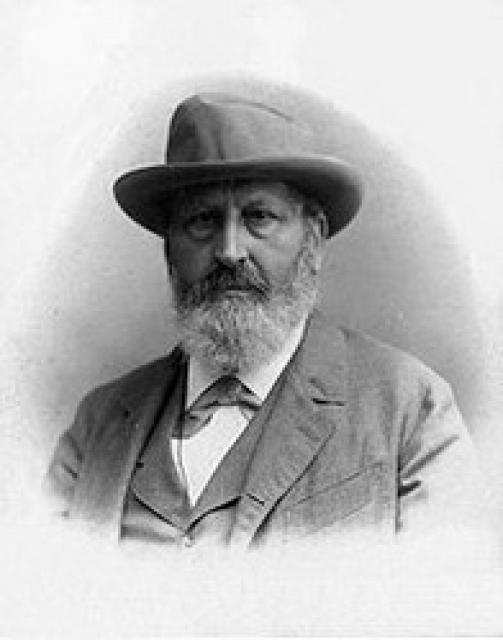
Eduard Suess
 Austria
- Early Life and Education
- Academic Career
- Scientific Contributions
- - "B?hmische Graptolithen" (1852)
- Later Life and Legacy
Early Life and Education
Eduard Suess was born on August 20, 1831, in London to a Saxon merchant family. In 1834, his family relocated to Prague, and in 1845, they moved to Vienna. Suess's passion for geology emerged at a young age, and he published his first work on the geology of Carlsbad at the age of 19.
Academic Career
In 1857, Suess became a professor of geology in Vienna. Besides his academic pursuits, he served on the city council, overseeing water supply and the Danube River regulation. Suess also played a significant role in the introduction of new education legislation in Lower Austria and was elected to the parliament (Reichsrat) in 1873. His eloquence and oratorical skills earned him a reputation as a brilliant left-wing politician.
Scientific Contributions
Suess made numerous groundbreaking contributions to geology, particularly in the stratigraphy of the Alps, Italian geology, and brachiopod taxonomy. His key works include:
- "B?hmische Graptolithen" (1852)
- "Brachiopoden der K?ssener Schichten" (1854)- "Brachiopoden der Hallst?tter Schichten" (1855)
- "Ueber den L?ss" (1866)
- "Charakter der ?sterreich. Terti?rablagerungen" (1866)
- "Aequivalente des Rotliegenden in den S?dalpen" (1868)
- "Die terti?ren Landfaunen Mittelitaliens" (1871)
- "Bau der italienischen Halbinsel" (1872)
- "Die Enstehung der Alpen" (1875)
"Das Antlitz der Erde"
Suess's magnum opus, "Das Antlitz der Erde" (1883-1888), remains a seminal work in geology. In this three-volume treatise, he synthesized the understanding of Earth's surface features and established the connection between the present-day distribution of oceans, continents, and mountain ranges to Earth's geological history.
Later Life and Legacy
In 1875, Suess proposed the term "biosphere" to describe the Earth's life-inhabited zone. He was elected to the Swedish Royal Academy of Sciences in 1895 and received the Copley Medal from the Royal Society of London in 1903. Suess's contributions to geology continue to shape our understanding of Earth's history and evolution. He passed away on April 26, 1914, leaving behind an indelible mark on the field of science.


