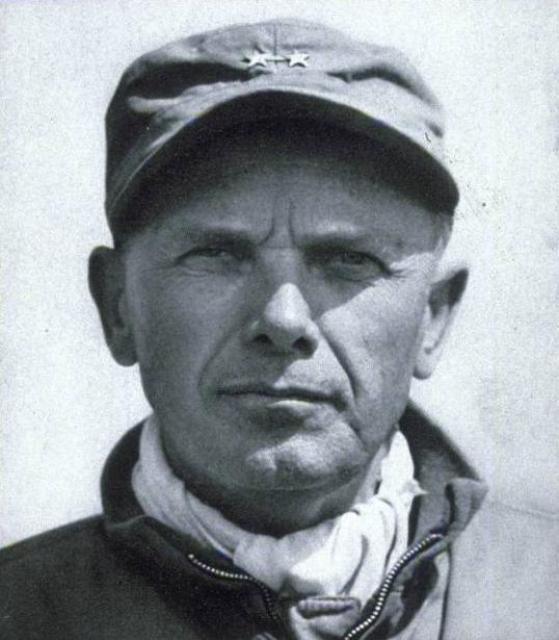
Edvard Almond
 USA
Edward Mallory “Ned” Almond was a U.S. Army officer whose career spanned three wars and a series of sharply contrasting legacies. He helped plan and lead the 1950 Inchon landing in Korea, one of the war’s pivotal operations, and later organized the evacuation of United Nations forces and civilians from Hungnam. His record also includes a deeply criticized command of the segregated 92nd Infantry Division in World War II, where his racial prejudice affected how he judged Black soldiers and the reasons for the unit’s difficulties.
A career built in the Army
Born in Luray, Virginia, on December 12, 1892, Almond graduated third in his class from the Virginia Military Institute in 1915. He served in France during World War I and rose through staff and command roles between the wars. In World War II, he first served as assistant commander of the 93rd Infantry Division and then took command of the 92nd, an African American division that fought in Italy.
The 92nd faced the structural disadvantages of a segregated Army, including unequal access to leadership positions and uneven support. Its performance in combat was troubled, but Almond’s response remains a major part of his legacy: he blamed the division’s Black soldiers and expressed racist views about their ability, rather than confronting how discrimination and command failures contributed to its problems. His assessments helped reinforce the Army’s prejudices against Black troops.
MacArthur’s trusted planner in Korea
After the war, Almond served in the Far East Command under General Douglas MacArthur, eventually becoming chief of staff. When North Korea invaded the South in 1950, MacArthur selected him to plan and command X Corps for the amphibious landing at Inchon. The operation landed on September 15, cut North Korean supply lines, and helped UN forces retake Seoul later that month.
Almond’s dual role as MacArthur’s chief of staff and X Corps commander gave him an unusually direct line to the theater commander, while complicating coordination with Eighth Army commander Walton Walker. After Inchon, X Corps moved into northeastern North Korea. Chinese forces intervened in November 1950 and struck the widely dispersed UN units near the Chosin Reservoir. The campaign ended in a difficult retreat, followed by Almond’s organization of the large-scale Hungnam evacuation in December, which moved troops, equipment, and many Korean civilians by sea.
A contested legacy
Almond became a lieutenant general and commanded the Army War College from 1951 to 1953, where he worked on officer education and military doctrine. He retired in 1953 after 36 years of service. His supporters remembered a hard-driving, loyal officer who could plan complex operations and act decisively under pressure. Historians have also emphasized his impatience, abrasive leadership, tactical mistakes, and racism. Both sides of that record matter: Almond’s role in Inchon and Hungnam was significant, but so was the harm caused by his beliefs and leadership of the 92nd Division. He died on June 11, 1979, aged 86.



