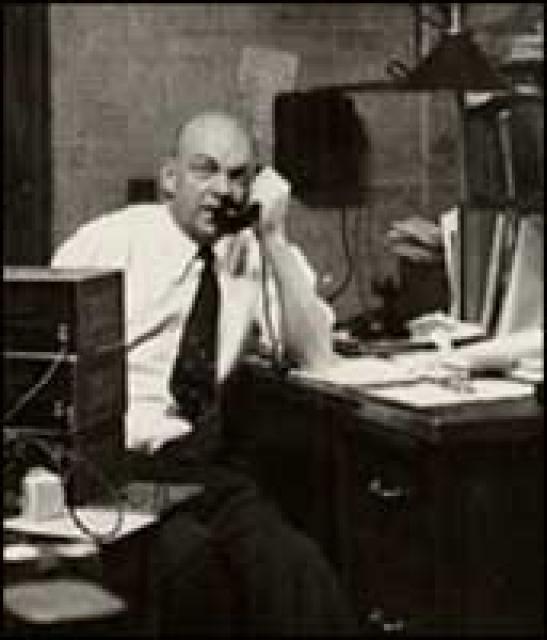
Edvin Armstrong
 USA
USA- Edwin Howard Armstrong: Pioneer of Radio Technology
- Early Life and Education
- Groundbreaking Innovations
- Superheterodyne Receiver
- FM and the Elimination of Interference
- Broadcasting Innovations
- Legacy and Impact
- Death and Recognition
Edwin Howard Armstrong: Pioneer of Radio Technology
Edwin Howard Armstrong was an American electrical engineer and inventor who revolutionized the field of radio. Born in New York City in 1890, he dedicated his life to advancing radio technology, leaving a lasting legacy that continues to shape our modern world.
Early Life and Education
Armstrong's passion for electronics manifested early on. He attended Columbia University, where he earned a degree in electrical engineering in 1913. During this time, he also served as an assistant in the electrical engineering department.
Groundbreaking Innovations
In 1912, Armstrong made a breakthrough discovery while studying the audion, a vacuum tube invented by De Forest. He developed the regenerative circuit, which allowed for a thousand-fold amplification of high-frequency signals. This invention laid the foundation for the development of the first practical radio receivers.
Superheterodyne Receiver
In 1918, Armstrong introduced the superheterodyne receiver, a highly sensitive and selective receiver that significantly improved radio performance. This technology became the standard for radio receivers for decades to come.
FM and the Elimination of Interference
Armstrong's work extended beyond receivers. In 1925, he began addressing the problem of radio interference. His solution was frequency modulation (FM), a method of transmitting sound by rapidly varying the frequency of the carrier wave. FM offered vastly improved audio quality and noise reduction.
Broadcasting Innovations
Armstrong established his own FM radio station in 1937 and continued to innovate. In 1953, he announced a revolutionary multiplexing technique that allowed multiple broadcasts to be transmitted on a single FM channel.
Legacy and Impact
Throughout his career, Armstrong pushed the boundaries of radio technology. His inventions and innovations have had a profound impact on the way we communicate and entertain ourselves. His work continues to inspire and shape the modern field of electronics.
Death and Recognition
Edwin Howard Armstrong died in New York City in 1954. His contributions to radio have earned him recognition as one of the greatest inventors of the 20th century. His legacy lives on through the countless devices and innovations that rely on his groundbreaking work.