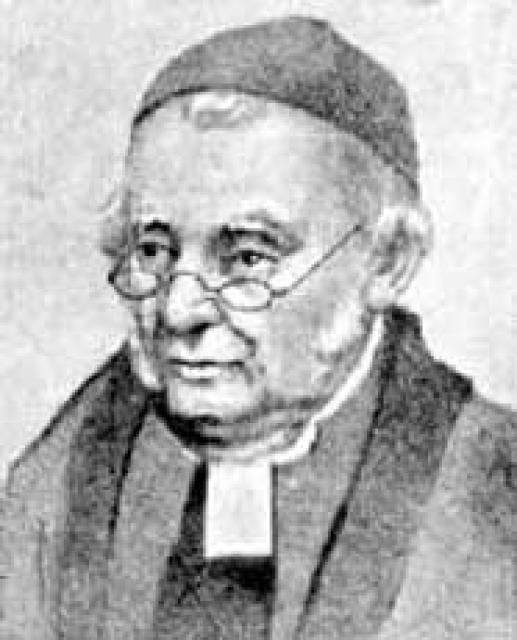
Edward Bouverie Pusey
 Great Britain
- Edward Bouverie Pusey: English Theologian and Oxford Movement Leader
- Career at Oxford
- The Oxford Movement
- Persecution and Controversy
- Theological Contributions
- Later Life and Legacy
Edward Bouverie Pusey: English Theologian and Oxford Movement Leader
Early Life and EducationEdward Bouverie Pusey was born on August 22, 1800, in Pusey, near Oxford. In 1818, he matriculated at Christ Church College, Oxford. After graduating, he became a Fellow of Oriel College in 1823. In 1824, he traveled to Germany to study Oriental languages and biblical criticism.
Career at Oxford
Pusey returned to Oxford in 1828, where he was appointed Regius Professor of Hebrew and a canon of Christ Church College. His keen interest in religion led him to involve himself in the publication of the "Tracts for the Times," which became a catalyst for the Oxford Movement.
The Oxford Movement
Pusey's involvement in the Oxford Movement, a religious revival within the Anglican Church, saw him advocate for a return to traditional Catholic doctrines and practices. He believed that the Church of England should emphasize the importance of the sacraments, clerical authority, and historical continuity.
Persecution and Controversy
Pusey's views drew the ire of university authorities. He was condemned unheard and suspended from preaching in the university for two years after delivering a controversial sermon entitled "The Holy Eucharist: A Comfort to the Penitent." Nonetheless, his influence as a leader of the Oxford Movement grew after John Henry Newman's conversion to Catholicism in 1845.
Theological Contributions
Pusey's writings and sermons addressed religious controversies and clarified doctrinal differences. His most significant theological work, "The Doctrine of the Real Presence," defended the Anglican belief in the real presence of Christ in the Eucharist. He also collaborated with Newman on the "Library of the Fathers of the Holy Catholic Church," translating and publishing important patristic works.
Later Life and Legacy
Pusey's final major work, a commentary on the minor prophets, showcased his passionate defense of fundamentalism. His death on September 16, 1882, left a lasting impact on the Anglican Church. His biography by H. P. Liddon remains a valuable source on the history of the 19th-century Church of England. Pusey House in Oxford, a museum and library dedicated to his memory, was opened two years after his death.