Edward Burne-Jones
 Great Britain
- Biography of Edward Burne-Jones
- Early Career and Influences
- Artistic Achievements
- Legacy and Rediscovery
Biography of Edward Burne-Jones
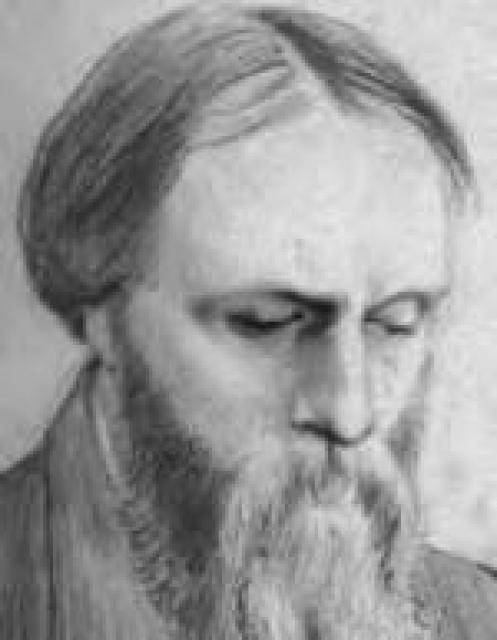
Edward Burne-Jones, an English artist, was born on August 28, 1833, in Birmingham, England. He attended King Edward's School in Birmingham and later studied at Oxford University, where he developed a close friendship with William Morris, who shared his admiration for Dante Gabriel Rossetti's illustrations of Tennyson's "The Early Englishman."
Early Career and Influences
In 1855, Burne-Jones and Morris traveled to France, where Burne-Jones was captivated by the Cathedral of Chartres, a symbol of medieval art. In 1856, he met Rossetti, who supported his desire to become an artist. Soon after, Burne-Jones and Morris founded the second phase of the Pre-Raphaelite Brotherhood and, in accordance with their neo-medieval aesthetic, created frescoes in the Oxford Union building in 1858.
While still under the influence of Rossetti, as evidenced by his painting "Clerk Saunders" (1861, Tate Gallery, London), Burne-Jones began to take an interest in Italian primitives, particularly Botticelli and Mantegna, as well as Michelangelo, after two trips to Italy in 1859 and 1862, accompanied by Ruskin.
Artistic Achievements
Burne-Jones exhibited seven of his paintings at the Grosvenor Gallery in 1877, which became a center for the Pre-Raphaelite movement. This exhibition marked the peak of his artistic reputation. In 1882, along with Lord Leighton, he represented Britain at the World Exhibition in Paris. In 1894, Burne-Jones was granted a baronetcy. During this time, he also created illustrations for Chaucer's works for Morris' Kelmscott Press in 1894.
Burne-Jones mainly painted works inspired by medieval or classical subjects, infused with symbolism and greatly influenced by Morris' poetry. He often turned to myths and legends, as seen in his works such as "The Story of Pygmalion" (1869-1879, Birmingham City Museum) and the series of six paintings inspired by Tennyson's "The Sleeping Beauty" (1871-1890, Farington House, collection of Lord Farington). Other notable works include "The Mirror of Venus" (1872-1877, Gulbenkian Foundation, Lisbon), "Laus Veneris" (1873-1875, Newcastle Museum), "The Golden Stair" (1880, Tate Gallery, London), "King Cophetua and the Beggar Maid" (1884, his most famous work), "Wheel of Fortune" (Paris, Musée d'Orsay), "The Garden of Pan" (1887, National Gallery of Victoria, Melbourne), and "Love Among the Ruins" (1894, Wightwick Manor).
Legacy and Rediscovery
Like most Pre-Raphaelites, Burne-Jones was known for his imaginative and sensual drawings and particularly for his skill in watercolor ("The Flower Book" 1882-1898, British Museum). He also created numerous cartoons for stained glass windows (including those in Dundee, Gatheshead, Allerton, and Edinburgh) and tapestries. His contemporaries highly valued the grace and contemplative figures in his paintings, with their ideal beauty that nostalgically evoked the past. After a period of obscurity, Burne-Jones' work has regained popularity today, thanks to a renewed interest in symbolism, of which he was one of the precursors. He has been a significant influence on artists such as Gustav Klimt.