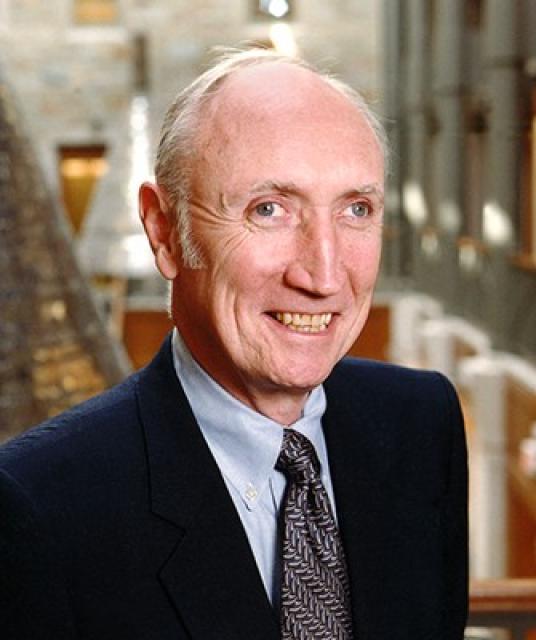
Edward J. Kane
 USA
- Education and academic career
- A warning about zombie banks
- Public service and recognition
- Personal life and legacy
Edward J. Kane was an American economist whose work changed how scholars and policymakers think about banking crises, deposit insurance, and the incentives created by financial regulation. He became known for warning that weak oversight could keep insolvent institutions alive at public expense, and for bringing the same sharp scrutiny to regulators that economists often applied to banks.
Education and academic career
Born in Washington, D.C., in 1935, Kane studied economics at Georgetown University, earning his bachelor’s degree in 1957. He completed a PhD in economics at the Massachusetts Institute of Technology in 1960. His early teaching appointments included Princeton University, Iowa State University, and Boston College, where he taught in the late 1960s and early 1970s.
In 1972, Kane joined Ohio State University as the Everett D. Reese Professor of Banking and Monetary Economics. He held the chair for two decades, building a reputation as a rigorous scholar and a forceful voice in debates over the structure and supervision of financial institutions. He returned to Boston College in 1992 as the first James F. Cleary Professor in Finance, retiring from the chair in 2009. Even after retirement, he continued writing and conducting research for many years.
A warning about zombie banks
Kane’s research treated regulation as part of the financial system itself: banks respond to rules, and those responses can reshape the risks that rules were meant to contain. He called this back-and-forth the “regulatory dialectic.” He argued that banks and other financial firms adapt to regulation through new products and practices, while regulators adjust their rules in turn. The resulting contest can generate new vulnerabilities when oversight fails to keep pace.
That perspective helped him identify problems in the U.S. savings and loan industry before its crisis erupted in the 1980s. Kane warned that institutions with hidden losses could continue operating when regulators delayed confronting their insolvency. He popularized the phrase “zombie bank” for a financially failed institution kept alive by explicit or implicit government support. Such institutions, he argued, could take on additional risks and shift their losses to taxpayers. His book The Gathering Crisis in Federal Deposit Insurance (1985) examined the pressures building around the federal deposit insurance system.
Kane later applied similar analysis to the financial upheavals leading to the Great Recession. His work focused on how deposit guarantees and other public safety-net support could alter banks’ incentives, encourage risk-taking, and obscure who ultimately bore the costs of financial distress. He wrote hundreds of scholarly articles and three books, and his research covered financial crises, deposit insurance, the politics of regulation, and the changing structure of financial services.
Public service and recognition
Alongside his academic career, Kane took an active role in policy discussions. He served as a research associate of the National Bureau of Economic Research, consulted for the Federal Deposit Insurance Corporation and the World Bank, and was a senior fellow at the FDIC’s Center for Financial Research. He was a founding member of the Shadow Financial Regulatory Committee, an independent group that issues recommendations on financial regulation.
Kane became president of the American Finance Association in 1979, at age 44, among the youngest people to hold the post. He also led the International Atlantic Economic Society and the North American Economics and Finance Association. In 2002, he shared the Adam Smith Award from the National Association for Business Economics for his contributions to financial policy debate.
Personal life and legacy
Kane was married to Gloria Verdi for 54 years. They had three children and a granddaughter. Beyond economics, he enjoyed horror films and comic books, collecting comics that were later donated to Boston College’s Burns Library.
Colleagues remembered him as both intellectually combative in public debate and personally warm with students and peers. He took a demanding approach to scholarship and devoted time to mentoring graduate students. Kane died in Tucson, Arizona, on March 2, 2023, at age 87. His influence remains visible in debates about deposit insurance, bank rescues, and the accountability of both financial institutions and their regulators.


