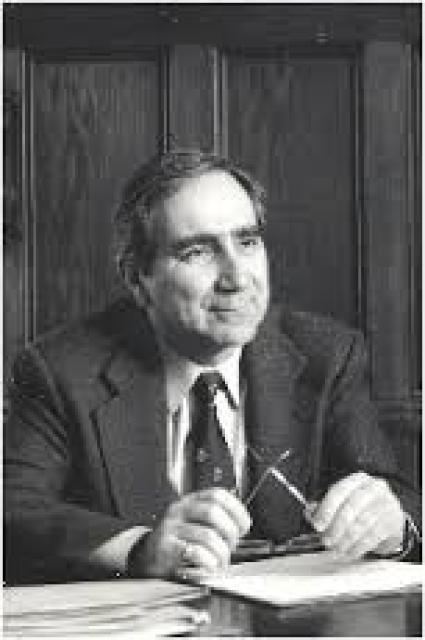
Hugo F. Sonnenschein
 USA
- Early Life and Education
- Scholarship and Academic Career
- University Leadership
- Later Years, Family and Legacy
Hugo F. Sonnenschein combined abstract economic theory with a rare appetite for institution-building. He became known for a result that challenged economists’ hopes of predicting how entire markets behave from assumptions about individual consumers, and later led the University of Chicago through a contentious period of expansion and financial change. His career also left a lasting mark on graduate education, academic publishing and the students he mentored.
Early Life and Education
Born in New York City on November 14, 1940, Sonnenschein lost his mother when he was very young and was raised in Brooklyn by his aunt, Mary. He later remembered Oakwood Friends School, which he attended from age 11 to 16, as an important part of his upbringing. The school gave him a strong academic foundation and exposed him to ideas about social responsibility and conscientious objection.
He entered the University of Rochester at 16 and initially struggled, by his own account, earning mediocre grades while sleeping during the day and playing poker at night. His path changed when he encountered the work of economist Kenneth Arrow, particularly the study of social choice. Mathematics and economics became his focus: he completed a bachelor’s degree in mathematics at Rochester in 1961, a master’s degree at Purdue in 1962 and a Ph.D. in economics at Purdue in 1964, at age 23.
Scholarship and Academic Career
Sonnenschein began teaching at the University of Minnesota in 1964, then moved to the University of Massachusetts Amherst in 1970 and Northwestern University in 1973. His early research examined the foundations of consumer choice and the way individual preferences combine into market demand. A 1965 paper in Econometrica helped establish an axiomatic approach to consumer choice that became standard in graduate microeconomics.
His best-known contribution emerged in papers published in 1972 and 1973. The work, later extended by Rolf Mantel and Gérard Debreu, showed that even if individual consumers behave consistently, the resulting market-level excess demand can take a remarkably wide range of forms. Known as the Sonnenschein–Mantel–Debreu theorem, the finding overturned expectations that relatively mild assumptions about individuals would yield neatly predictable aggregate demand. It forced economic theorists to be more careful about what could—and could not—be inferred about an economy from the choices of its members.
At Princeton University, where he joined the faculty in 1976, Sonnenschein became a central figure in economic theory. He edited Econometrica from 1977 to 1984, guiding the journal toward a broader range of research while demanding rigor and clarity. He also helped develop work on social choice and game theory, including research with Robert Wilson and Faruk Gul on the Coase conjecture. Colleagues and former students remembered him as an unusually attentive mentor who encouraged independent thinking and sustained relationships long after graduation.
University Leadership
Sonnenschein’s administrative career included serving as dean of the University of Pennsylvania’s School of Arts and Sciences from 1988 to 1991 and as Princeton’s provost from 1991 to 1993. In 1993 he became the 11th president of the University of Chicago, a position he held until 2000.
His presidency focused on strengthening the university’s financial base and improving undergraduate life without weakening its academic standards. In a 1996 letter to faculty, he proposed growing the College, expanding fundraising and investing in classrooms, laboratories, housing and student support. Those proposals triggered sharp debate among faculty and traditionalists who feared that expansion could compromise the university’s character. Sonnenschein pressed ahead, arguing that new resources were necessary to sustain its research and teaching. The reforms continued after his departure and helped shape the university’s later growth.
Later Years, Family and Legacy
After stepping down as president, Sonnenschein returned to teaching and research at Chicago, where he became the Adam Smith Distinguished Service Professor of Economics. He taught game theory and microeconomic theory and continued publishing research into his later years. He was elected to the National Academy of Sciences in 1990, became a fellow of the American Academy of Arts and Sciences and was named a Distinguished Fellow of the American Economic Association.
He met Elizabeth “Beth” Gunn during his first year at Rochester; she later earned a Ph.D. in epidemiology. They raised three daughters, Leah, Amy and Rachel, and took pride in their five grandchildren. Sonnenschein died on July 15, 2021, at age 80. Remembered as a demanding scholar and a warm, loyal mentor, he left both a foundational theorem in economic theory and a deep institutional legacy at the University of Chicago.


