Edward Voinilovich
 Belarus
- Early Life and Education
- University and Engineering Career
- Land Management and Social Engagements
- Political Career in the Russian Empire
- Tragedy and Religious Endeavors
- Involvement in the Belarusian and Polish Movements
- During the German Occupation
- Return to Belarus and Last Years
Early Life and Education
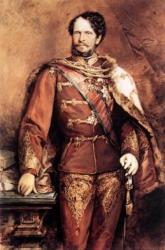
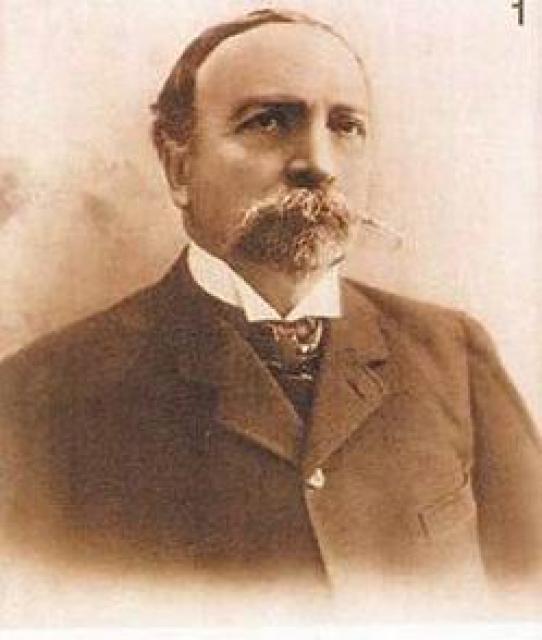
Edward Woyniłowicz, a prominent Belarusian and Polish statesman, was born on October 13, 1847, in the village of Slepianka near Minsk. A descendant of the noble Woyniłowicz family, he received his early education at the Slutsk Gymnasium and graduated in 1861.
University and Engineering Career
In 1865, Woyniłowicz pursued higher education at the Imperial Technological Institute in St. Petersburg, graduating in 1869. He then enrolled at the Agricultural Academy in Pruszków, Poland, in 1872. Following his studies, he interned in factories in Germany and Belgium before becoming an engineer-technologist at the Putilov Factory in St. Petersburg.
Land Management and Social Engagements
After his father's death, Woyniłowicz returned to his family estate in Savichi, where he applied innovative agricultural techniques to the family's lands. He was appointed an honorary judicial magistrate in 1883 and vice-chairman of the Minsk Society of Agriculture in 1888.
Political Career in the Russian Empire
Woyniłowicz was elected to the Russian State Duma, representing the Minsk governorate, on three occasions. In 1906, he became a member of the Russian State Council. He refused an offer to serve as Deputy Minister of Agriculture in the Russian Empire, which was proposed by Prime Minister Pyotr Stolypin.
Tragedy and Religious Endeavors
In 1882, Woyniłowicz married Olimpia Uzłowska, with whom he had two children. However, tragedy struck when his daughter Helena and son Simon passed away at young ages. To honor their memory, he decided to build the Church of Saint Simon and Helena on the outskirts of Minsk, which was completed in 1910. He also supported the construction of both Orthodox and Catholic churches.
Involvement in the Belarusian and Polish Movements
While sympathetic to the Belarusian national movement, Woyniłowicz's status as a landowner prevented him from fully embracing the left-wing views prevalent at the time. He participated in meetings of the Belarusian National Rada and supported the establishment of the Belarusian People's Republic in 1917.
During the German Occupation
In 1918, under German occupation, Woyniłowicz proposed a plan to restore the Grand Duchy of Lithuania. He created the Union of Landowners of the Minsk Governorate and participated in the establishment of the Union of Poles from Belarusian Borderlands. He also played a role in creating the Polish-Belarusian Society for Cultural and Political Cooperation in Belarus.
Return to Belarus and Last Years
In 1919, Woyniłowicz returned to his estate in Savichi and continued his social and political activities. He advocated for an independent Belarus in alliance with Poland and opposed the partition of Belarus by Polish and Bolshevik forces.