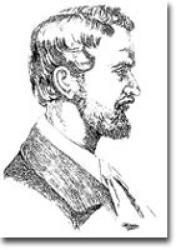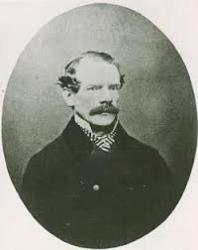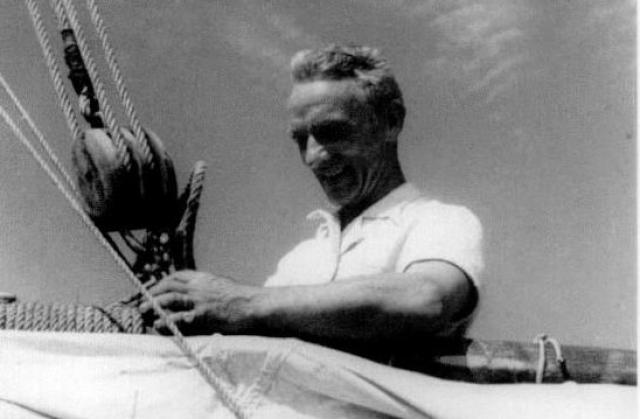
Eric de Bisschop
 France
- A Life of Adventure and Exploration
- Naval Service in World War I
- Post-War Adventures
- Explorations in the Pacific
- Conflict with the Japanese
- "Kaimiloa" and the Trans-Pacific Voyage
A Life of Adventure and Exploration
Early YearsÉric de Bisschop was born into an aristocratic family in France, receiving the title of Baron. As a child, his passion for the sea led him to study oceanography, but the bureaucratic nature of the profession left him unfulfilled.
Naval Service in World War I
In 1914, Bisschop joined the French navy as a volunteer, serving as a captain on a minesweeper. However, his ship was soon sunk, and he was rescued by a patrol vessel. Bisschop then transitioned to aviation, where his plane crashed into the sea, leading to his rescue by a reconnaissance seaplane. He spent the war years recovering in a hospital.
Post-War Adventures
After the war, Bisschop married and became an entrepreneur in construction. In 1927, he purchased a ship to transport timber from West Africa, but it capsized and sank during a storm. That same year, Bisschop divorced and traveled to China, where he joined the police force before becoming a personal advisor to a Chinese general.
Explorations in the Pacific
In 1932, Bisschop built a junk, the "Fou Po," to study Pacific currents. With his companion, Joseph Tatibouet, he sailed the junk in November 1932, but it wrecked near Taiwan. The crew was rescued by locals.
Undeterred, Bisschop constructed a new junk, the "Fou Po II," in 1933. He set sail to cross the Pacific from east to west, studying currents and testing theories about Polynesian sea voyages. Zigzagging to measure the current's width, Bisschop discovered shipworms and repaired the junk on Seram Island, where he sold Chinese antiques to replenish his funds.
In July 1934, the "Fou Po II" was damaged in a storm and beached on New Guinea, where indigenous people provided assistance. The junk resumed its voyage in February 1935.
Conflict with the Japanese
Tatibouet eventually grew weary and demanded to be dropped off, which occurred on July 22. The nearest land was Japanese-controlled Jaluit Atoll. Despite Bisschop's warnings about Japanese hostility towards foreigners, Tatibouet disembarked, leading to his arrest and the expedition's detention. On August 7, the Japanese released the crew but ordered them to leave.
Determined to drop off Tatibouet in Hawaii, Bisschop sailed on. However, the Japanese had spoiled all the food during their search for evidence, leaving the voyagers with a dire supply. They survived on biscuits for over a month. On October 25, 1935, they reached Molokai, where local residents rescued them. The junk was wrecked in a storm on October 27.
"Kaimiloa" and the Trans-Pacific Voyage
Undeterred, Bisschop immediately began constructing a new vessel based on Polynesian designs. Named "Kaimiloa" after a Tahitian legend, it was a twin canoe measuring 11.58 meters in length.
In Honolulu, Bisschop met a woman named Papaleaiaina (later revealed to be Constance Constable), who became a close companion. In November 1936, Bisschop decided to return to France rather than continue his research, which Tatibouet was unwilling to pursue.
In March 1937, the "Kaimiloa" was ready for sea. The voyage proved remarkably successful. It reached Wallis Island from Hawaii in a month and Cape Town on the 59th day. The journey beyond was less smooth: "Kaimiloa" was blown towards the edge of the polar ice cap, resulting in a 100-day passage from Cape Town to Tangier.
Nevertheless, the voyage demonstrated the superiority of Polynesian seafaring techniques to European counterparts. The "Kaimiloa" averaged over a hundred miles per day, an impressive speed. From Tangier, Bisschop sailed to his final destination, Cannes, in May 1938, completing the journey in 264 days.