Ernst Abbe
 Germany
Biography of Ernst Abbe
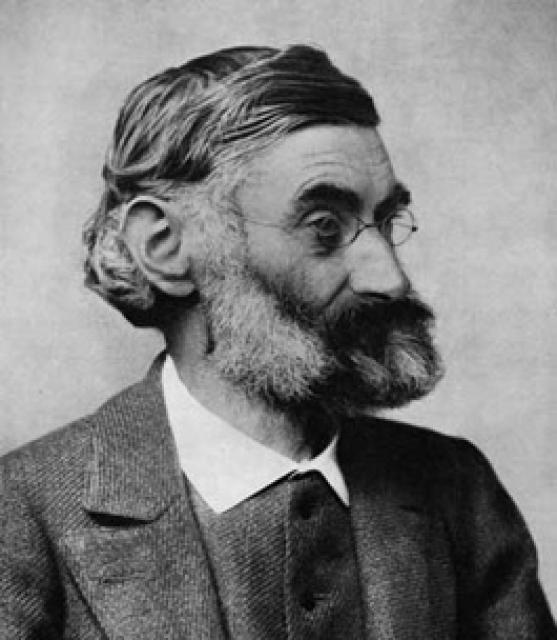
Ernst Karl Abbe, a German physicist and optician, is considered one of the founders of modern optics along with Otto Schott and Carl Zeiss. Abbe developed numerous optical instruments and was a co-owner of Carl Zeiss AG, a German manufacturer of research microscopes, astronomical telescopes, and medical equipment. In his honor, a lunar crater was named Abbe.
Early Life and Education
Ernst Karl Abbe was born on January 23, 1840, in Eisenach, Saxe-Weimar-Eisenach, Germany. He came from a poor family, and his father worked as a master weaver to earn a living. The owners of the textile factory helped Abbe attend school and enroll in university with good grades. Even while in school, Abbe made it known that his scientific talents and determination would ensure his success in life, as long as he received financial support. He studied at the University of Jena and the University of Göttingen, while also giving private lessons to be less dependent on the favor of factory bosses.
On March 23, 1861, Abbe received his doctorate degree in Göttingen. On August 8, 1863, he became a qualified lecturer at the University of Jena, and by 1870, he signed a contract to serve as an extraordinary professor of physics and mathematics. In 1871, he married Else Snell, the daughter of mathematician and physicist Karl Snell, one of Abbe's teachers. Abbe continued to advance in his career and in 1878, he was appointed as the head of the astronomical and meteorological observatory in Jena. In 1889, he became a member of the Bavarian Academy of Sciences and also a member of the Saxon Academy of Sciences.
Contributions to Optics
Abbe invented the apochromatic lens, a lens for microscopes that eliminates chromatic aberration, in 1868, after becoming the director of research at the Zeiss Optical Works. He developed the first refractometer for measuring the refractive index of liquids and solids and described his device in a scientific brochure published in 1874. The Abbe number, a measure of light dispersion in transparent materials, was named after him. While working at the University of Jena, Abbe received an invitation from Carl Zeiss, the German optician, to apply his talents to improve the process of manufacturing optical instruments, a process that was mainly based on trial and error at that time. Abbe was the first to define the concept of numerical aperture, which characterizes the efficiency of light input into optical fibers.
After Zeiss' death in 1888, Abbe became the sole owner of Carl Zeiss AG, and a series of transformations began. Abbe believed that fruitful work is based on cooperation between all social classes. He outlined the rights and responsibilities of his workers, placing great importance on social issues. Under Abbe's leadership, an 8-hour workday was introduced, and he also took care of a 12-day vacation, pension payments, and other benefits. Part of the profits from Carl Zeiss AG, which was a significant enterprise in Jena, was dedicated to scientific research, cultural and educational tasks, and funds were always set aside for the company's "reanimation" during unfavorable economic periods. This approach allowed the optician to build a physical laboratory for the University of Jena, a children's hospital, a stadium, a planetarium, a shelter for children, and more, all during his lifetime.
Abbe stepped down from his responsibilities in Jena in 1891. He passed away on January 14, 1905.