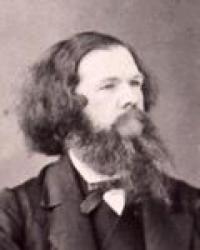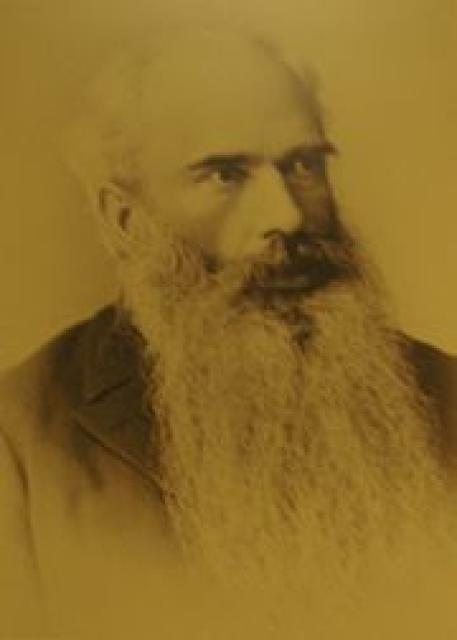
Ernst Faber
 Germany
Biography of Ernst Faber
Ernst Faber was a German missionary, sinologist, and botanist, known for his research on the Chinese language and literature. He was also a translator of the Gospel of Mark into Chinese.
Early Life and Education
Faber was born into a tinsmith's family and was the third of eleven children, only three of whom survived. He was sent to school, where he excelled academically and received awards for his outstanding achievements. However, in 1852, he began learning the trade of a tinsmith. In 1855, he wanted to attend a technical school in Berlin but did not have the necessary funds. He moved to Barmen in search of work in 1856, where he joined a youth evangelical society and decided to dedicate his life to missionary work. From 1858 to 1862, he served as an assistant teacher in Eberfeld, attempted to pass exams to become a teacher, but ultimately joined a seminary. He completed his studies there in 1862 and was accepted into the University of Basel. It was during his time at Basel that he developed a keen interest in philology and philosophy, which shaped his personal growth.
Missionary Work in China
On Easter 1863, Faber transferred to the University of Tübingen, and in 1864, he joined the Rheinische Missionsgesellschaft (Rhenish Missionary Society) in China. Due to the illness of the mission's leader, Faber was able to intern at the Berlin Observatory, the Zoological Museum, and the Geographisches Institut Perthes in Gotha. On August 10, 1864, Faber was ordained as a Lutheran priest. He then traveled through Amsterdam and London before arriving in Hong Kong on April 25, 1865. He started his service at a missionary station in Fuzhou, where he practiced as a doctor while intensively studying the Chinese language. Remarkably, he treated approximately 6,000 patients in just one year, despite having no formal medical training.
In 1870, Faber became engaged to the daughter of a priest; however, she passed away from tuberculosis in 1874, and he never married. In 1876-1877, Faber was granted a one-year leave of absence in Germany, during which he gained recognition as a lecturer. Upon his return to China, he preached in Guangzhou until 1883. During this period, he developed a strong interest in botany and collected a herbarium of around 4,000 plant species. He also described 120 new plant species.
Later Years and Legacy
In 1880, Faber had a conflict with the head of the mission, Hubrig, regarding their methods of approaching the Chinese. In 1881, he left the Rheinische Missionsgesellschaft and returned to Germany for a year. In 1883, he returned to Hong Kong, where he joined the newly established Allgemeinen evangelischen protestantischen Missionsverein (General Evangelical Protestant Missionary Association). In the same year, he founded an autonomous Chinese Protestant community in Hong Kong. In 1886, Faber moved to Shanghai. In 1887, he embarked on a botanical expedition to Sichuan and in 1890 to Manchuria. These botanical trips were combined with his missionary work. Unfortunately, on August 22, 1892, a fire broke out in Shanghai, destroying Faber's library and herbarium. Fortunately, all the materials had been published in the treatise titled "Botanicon Sinicum. Notes on Chinese botany from native and western sources."
In 1893, Faber participated in the World's Parliament of Religions in Chicago, USA, where he delivered a lecture on Confucianism. He also visited the Hawaiian Islands during this time. In April 1898, Faber moved to Qingdao, which had recently become a German possession. He made trips to Beijing and Tianjin but contracted dysentery in early 1899 and passed away in Qingdao. He was buried in the European cemetery, but his grave was destroyed during the Cultural Revolution in China between 1966 and 1976.
Faber received an honorary doctorate in theology from the University of Jena in 1888. In 1890, he was elected vice-president of the Society for the Promotion of Education in China (Gesellschaft für Hebung des Erziehungswesens in China). In China, two clinics in Qingdao were named after him (until 1949). Furthermore, in his hometown of Coburg, Germany, there has been a street named after Faber since 1928.