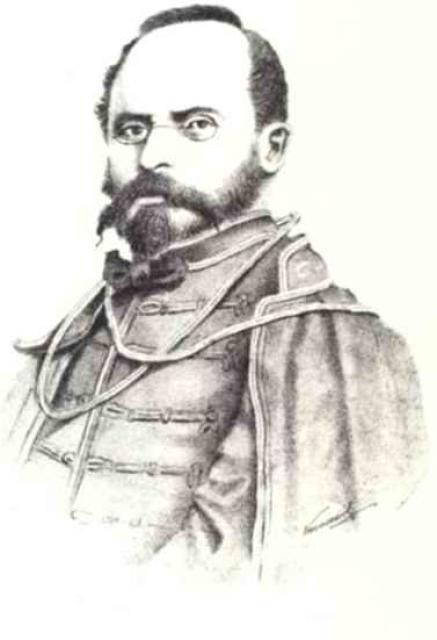
Eugen Kvaternik
 Croatia
- Eugen Kvaternik: Croatian Nationalist and Political Leader
- Political Activism
- Founding the Croatian Party of Right
- Struggle for Independence
- The Rakovica Uprising
- Literary Legacy
- Croatia and the Italian Confederation (1859)
Eugen Kvaternik: Croatian Nationalist and Political Leader
Early Life and EducationEugen Kvaternik was born into a family of educators on October 31, 1825, in Zagreb, Croatia. He embarked on a theological journey, studying at Sinj and Zagreb from 1842-1844. Subsequently, his pursuit of knowledge expanded to the fields of law (1844-1845) and pedagogy (1845-1846) at Pest. By 1847, he had earned the right to teach, followed by the authorization to practice law in 1848.
Political Activism
When Ban Josip Jelačić abolished feudalism in 1848, it granted Croats greater autonomy from Austria-Hungary. This ignited hopes of complete independence, which Kvaternik embraced fervently. After working as a lawyer in Brod na Kupi (1851-1857), he faced a ban on his profession and was forced to leave Austria-Hungary.
Seeking support for his political ambitions, Kvaternik ventured to the Russian Empire in 1858 but met with disappointment. Undeterred, he shifted his alliance to France. Upon his return to Zagreb in 1860, he was elected to the Sabor (Parliament).
Founding the Croatian Party of Right
On June 26, 1861, Kvaternik and Ante Starčević presented a proposal in the Sabor, demanding extensive autonomy for Croatia within the Habsburg Monarchy. This marked the birth of the Croatian Party of Right, with June 26th commemorated as its founding date.
Struggle for Independence
Kvaternik's advocacy for Croatian independence drew the ire of authorities. In 1862, he was arrested and later banished from Austria-Hungary. While in Italy, he collaborated with Giuseppe Garibaldi and other exiled groups. Following the coronation of Franz Joseph in 1867, Kvaternik was permitted to return home.
In October 1871, Kvaternik, along with members of the Croatian Party of Right, initiated an uprising in Rakovica, Kordune. Their manifesto proclaimed the liberation of Croatia from Austrian and Hungarian rule, the establishment of an independent Croatia, equality under the law, and the abolition of the Military Frontier.
The Rakovica Uprising
Despite their appeals for Orthodox Serb support, the Rakovica uprising was short-lived. The rebels were swiftly defeated, and many, including Kvaternik, were killed.
Literary Legacy
Kvaternik's passion for Croatian nationalism extended beyond his political activities. He penned several influential works, including:
Croatia and the Italian Confederation (1859)
Political Studies (1861-1862)The Croatian Capitalist (1863)
The Eastern Question and the Croats (1868)
Commemoration and Legacy
Today, numerous streets and squares in Croatian cities bear the name of Eugen Kvaternik. His legacy as a Croatian nationalist and political pioneer continues to resonate with his people.


