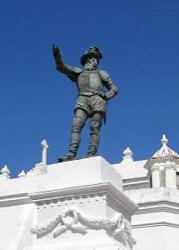
Eugen Savoyen
 Austria
Biography of Prince Eugene of Savoy
Prince, Austrian military leader, and statesman, field marshal, generalissimo.
Prince Eugene of Savoy was born into a prestigious family, with a noble lineage from both his father and mother's side. His father, Count de Soissons, belonged to the ancient House of Savoy, which later became the Kings of Sardinia and Sicily. On his mother's side, he had a mix of Roman patrician ancestry as well as more common backgrounds, such as hat-makers and servants. Despite rumors circulating in Paris that Eugene was the illegitimate son of King Louis XIV, these claims were vehemently denied by the king himself, and Eugene fell out of favor in the French court.
Seeking a new life away from Paris, Eugene found his calling in Austria, a country actively fighting against Turkish aggression at the time. His exceptional military talents were evident from his very first battle, where he successfully lifted the siege of Vienna in 1683. Impressed by his abilities, Emperor Leopold I immediately gave him command of a dragoon regiment. This marked the beginning of Eugene's illustrious career, which culminated in his appointment as a field marshal at the age of 29 – an unprecedented achievement even in an era of rapid promotions.
Throughout his career, Eugene participated in 24 battles, seven of which had a significant impact on world history. Two notable battles were the Battle of Zenta in 1697 and the Battle of Malplaquet in 1709. In the former, Eugene led the Austrian forces against the Turks, marking a turning point in the Austrians' struggle against Turkish aggression. The latter battle, fought in the Netherlands, involved a coalition of English, Dutch, and Austrian forces fighting against the French for control of the Spanish inheritance. Eugene's strategic brilliance played a vital role in both engagements.
Aside from war, Prince Eugene had a sense of humor and enjoyed making jokes even about serious matters. During the Battle of Philipsburg in Germany, he famously suggested turning the Rhine River backward to flood the enemy camp, much to the surprise of his subordinates. It turned out to be a jest, reflecting his distinctive sense of humor.
Another passion of Prince Eugene was books. Following his death, his palace in Vienna housed tens of thousands of volumes encompassing a wide range of subjects, from light literature of the time to profound philosophical works. These books later formed the foundation of the Austrian National Library, a testament to Eugene's intellectual pursuits.
Overall, Prince Eugene of Savoy's military achievements, wit, and love for knowledge left a lasting legacy. His exceptional leadership skills and strategic genius contributed significantly to European history, shaping the course of major conflicts of his time.