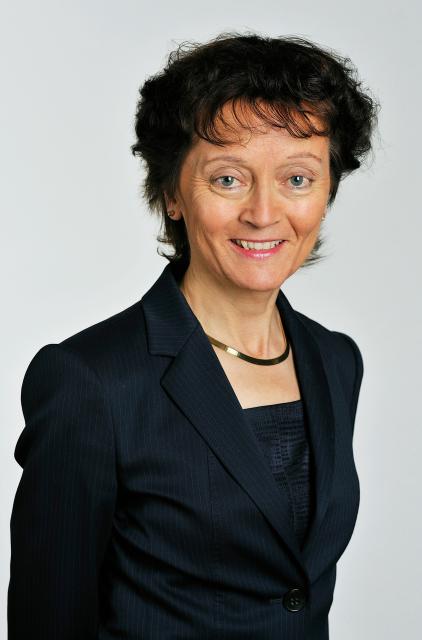
Eveline Widmer-Schlumpf
 Switzerland
Eveline Widmer-Schlumpf rose from cantonal politics in eastern Switzerland to the country’s seven-member Federal Council, where she led the justice and finance departments and served as president of the Swiss Confederation in 2012. A lawyer by training, she became a prominent figure in Swiss politics after a dramatic parliamentary election in 2007 and later helped guide the country through the financial crisis and changes to its banking and tax policies.
Law and cantonal politics
Widmer-Schlumpf was born on March 16, 1956, in Felsberg, in the canton of Graubünden. She grew up with two sisters in a politically engaged family: her father, Leon Schlumpf, served on the Federal Council from 1979 to 1987 and was president of the Confederation in 1984.
She studied law at the University of Zurich, graduating in 1981, and later earned a doctorate in law. After returning to Graubünden, she qualified as a lawyer and notary and worked in private practice. She was elected to the district court of Trin in 1985, serving as its president from 1991 to 1997.
Her political career expanded from the local to the cantonal level. She joined the Graubünden legislature in 1994 and was elected to the cantonal government in 1998. From 1999 through 2007 she led the canton’s finance department, and she chaired the Conference of Cantonal Finance Directors from 2001. The roles gave her a strong grounding in Switzerland’s federal system and public finances.
A dramatic election to the Federal Council
On December 12, 2007, the United Federal Assembly elected Widmer-Schlumpf to the Federal Council, Switzerland’s collective executive, in place of incumbent Christoph Blocher. The unexpected result created a major split within the Swiss People’s Party (SVP), to which both belonged. She accepted the election and took office in January 2008; after the party expelled her, she became a leading figure in the newly formed Conservative Democratic Party (BDP).
Widmer-Schlumpf first headed the Federal Department of Justice and Police, from 2008 to 2010, before taking charge of the Federal Department of Finance. She was elected president of the Swiss Confederation for 2012. In Switzerland, the presidency rotates annually among members of the Federal Council and is primarily a representative role, while executive authority remains shared by the council.
Finance minister and later work
As finance minister, she faced the effects of the global financial crisis and worked with the Swiss National Bank and financial regulators on measures to stabilize UBS in 2008. Her tenure also coincided with growing international pressure on Switzerland’s tradition of banking secrecy. Under her leadership, the government advanced cooperation with foreign authorities on tax matters and reforms that changed the country’s approach to banking confidentiality.
Widmer-Schlumpf announced in 2015 that she would not seek another term and left the Federal Council at the end of that year. Since 2017 she has chaired the foundation board of Pro Senectute, a Swiss organization supporting older people. She is married and has three children.
Widmer-Schlumpf’s career reflects the distinctive path of Swiss politics, where cantonal experience, negotiation and collective government are central. Her election reshaped party alignments, while her years in the finance department placed her at the center of a consequential period for Switzerland’s banking sector and its relationship with the wider world.