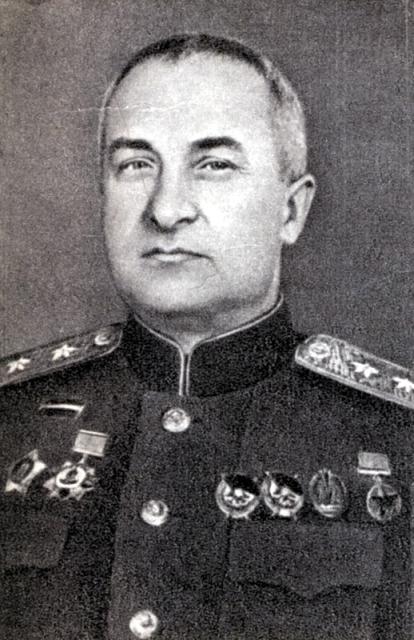
Evgeniy Zhuravlev
Early Life and Military Career
Yevdokim Pavlovich Zhuravlev was born in the village of Rud'kovka, now part of the Bobrovytskyi district of the Chernigov region in Ukraine. He joined the Russian Imperial Army in 1915 and graduated from the 2nd Peterhof Student School of Warrant Officers, becoming a warrant officer. He participated in the February Revolution in Petrograd and commanded a company on the Southwestern Front during World War I.
Red Army Service
In 1918, Zhuravlev joined the Red Army. During the Russian Civil War, he served as an elected detachment commander, chief of staff of an operation division for a Cossack cavalry brigade, and reconnaissance chief for a division. He participated in battles on the Southern, Western, and Southwestern Fronts.
Interwar Period
During the interwar period, Zhuravlev served as chief of staff of a division, assistant commander of a regiment, and commander of a cavalry division of the 7th Cavalry Corps. He graduated from the Red Army Command Staff Advanced Training Courses at the M.V. Frunze Military Academy (1925 and 1929) and the Frunze Military Academy (1935). From 1936, he served as chief of staff of the 5th Cavalry Corps. On February 17, 1936, he was promoted to "kombrig" (brigade commander). In October 1937, he became a senior lecturer in tactics at cavalry courses for the advanced training of command staff, and later returned to the position of chief of staff of a cavalry corps. In March 1940, he participated in the Soviet-Finnish War as chief of staff of the 3rd Cavalry Corps in the 7th Army. On June 4, 1940, after the introduction of general ranks in the Red Army, Zhuravlev was promoted to "general-major" (major general). From June 1940, he served as deputy commander of the 5th Mechanized Corps.
Great Patriotic War
At the beginning of the Great Patriotic War, Zhuravlev held the same position. After the death of Major General I.P. Alekseenko on August 3, 1941, he took command of the remnants of the 5th Mechanized Corps, which was part of the 16th and then the 20th Armies of the Western Front. The corps participated in heavy defensive battles in the area of the cities of Shepetovka, Slavuta, and Ostrog, and later in Belarus. Twice, the units of the corps broke out of encirclement in its entirety, inflicting significant losses on the enemy.
From August 1941, he served as deputy commander of the 30th Army, which fought in heavy defensive battles in the area of the city of Rzhev, on the outskirts of Moscow. From November 11, 1941, he became chief of staff of the Kalinin Front, leading the retreating Soviet troops in the area of the settlements of Zavidovo and Spas-Zaulkok. He was severely wounded and after recovering in the hospital, he was appointed assistant commander of the Kalinin Front for formations, preparing marching units and parts for the front, and repeatedly traveled to the troops to oversee combat operations in individual areas.
From September 8, 1942, Zhuravlev commanded the 29th Army of the Western Front, which defended on the left bank of the Volga River. From January 31, 1943, he commanded the 53rd Army, which held the Demiansk bridgehead. From March 21, 1943, he commanded the 68th Army of the Northwestern Front, which distinguished itself in several offensive battles in the interfluve of the Lovat and Redya rivers and in the Smolensk offensive operation. On September 9, 1943, Zhuravlev was promoted to "general-leitenant" (lieutenant general).
From October 24, 1943, he commanded the 21st Army, which was located in the area of the city of Kalinin for reorganization and replenishment. From February 6, 1944, he commanded the 18th Army of the 1st and then 4th Ukrainian Fronts. The army's troops distinguished themselves in the Proskurov-Chernivtsi and Lviv-Sandomierz offensive operations. Having crossed the Southern Bug River, the army's troops reached the Carpathians and from May conducted combat operations in difficult mountainous conditions. In the East Carpathian strategic offensive operation, the army's troops under the command of Zhuravlev participated in the liberation of the cities of Mukachevo, Uzhhorod, and Chop. From November 1944, Zhuravlev was at the disposal of the General Directorate of Personnel of the NKO.
Post-War Career
After the war, Zhuravlev served as deputy commander of an army, then deputy commander of the troops of the Carpathian Military District for educational institutions. From November 1945, he was general inspector of infantry troops of the Main Inspectorate of the Soviet Armed Forces, deputy chief inspector of the Soviet Army for ground forces, and assistant commander of the troops of the South Ural Military District. From March 1955, he was chief of the personnel department of the Ground Forces. In December 1960, he retired from military service. He passed away on May 11, 1983, in Moscow.