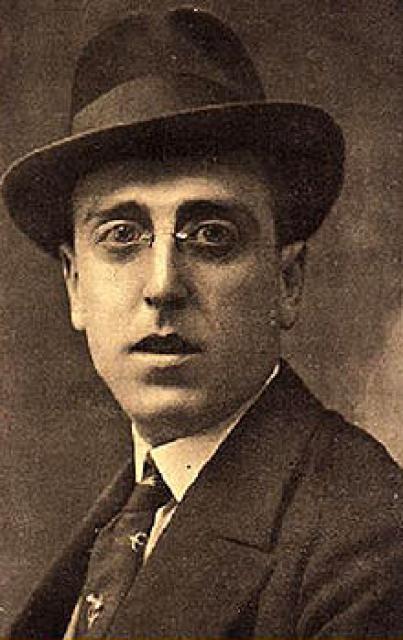
Federico Romero
 Spain
Spain- Biography of Federico Romero
- Early Life and Career
- Collaboration with Carlos Fernández Shaw
- Contributions to Zarzuela
- Later Life and Legacy
Biography of Federico Romero
Federico Romero was a Spanish poet and essayist who lived with his family in the La Mancha region in the city of La Solana at the beginning of the 20th century. It was here that he composed the libretto for the famous zarzuela "La rosa del azafrán" by composer Jacinto Guerrero. Since 1982, the Federico Romero Prize (Premio Federico Romero) has been awarded in Spain to authors and performers in the genre of zarzuela.
Early Life and Career
Federico Romero was born in 1886 into a well-off Spanish family. His father worked at the Bank of Spain, and his aunt owned a large estate in La Mancha. Initially, Romero studied to become a mining engineer, but due to health problems related to his years spent in the mines, he joined the Spanish Postal Service and worked as a telegraph operator from 1907 to 1917. It was during this time that he began his literary career. In 1911, he published the poem "Nochebuena en la Central" in the magazine El Telegrafista Español.
Collaboration with Carlos Fernández Shaw
Romero had a close friendship with the renowned Spanish writer Carlos Fernández Shaw. After Shaw's death, Romero collaborated with his son Guillermo Fernández Shaw, and together they created 70 librettos. Their first collaboration was in 1916 for the zarzuela "La canción del olvido" by José Serrano. A year after its successful premiere, Romero left his job as a telegraph operator and dedicated himself fully to his literary work. However, he continued to maintain contact with his former colleagues and wrote articles for the magazines El Telégrafo Español and El Electricista until the 1930s.
Contributions to Zarzuela
Over the course of nearly thirty years of collaboration with Fernández Shaw, they wrote most of the well-known librettos for zarzuelas in Spain. They were considered the main authors and lyricists for contemporary Spanish musicians. They created original texts and also adapted works by famous authors such as Lope de Vega, Manuel Machado, and Jacinto Benavente. Romero and Fernández Shaw also adapted works by Goethe, Schiller, and Rostand for the Spanish stage. Their literary partnership ended in the late 1940s due to disagreements, with Romero continuing his literary career alone and Fernández Shaw collaborating with his brother Rafael.
Later Life and Legacy
Romero was one of the founders of the Society of Spanish Authors and Publishers (Sociedad General de Autores y Editores), where he served as an advisor. He was also involved in the establishment of the Institute of Madrid Studies (Instituto de Estudios Madrileños). Romero published several monographs on the history of Madrid, including "Por la calle de Alcalá" (1953), "Prehistoria de la gran vía" (1966), and "Mesonero Romanos, activista del madrileñismo" (1968). Federico Romero passed away in Madrid on June 30, 1976, at the age of 89 and was buried in the Cemetery of La Almudena. One of the primary schools and a street in his hometown of La Solana are named in his honor.


