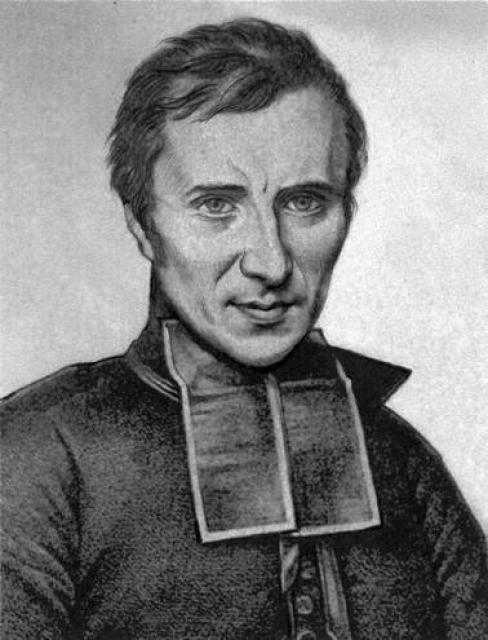
Felicite Lamennais
 France
- Felicité Robert de Lamennais: A French Literary and Religious Figure
- Religious Vocation and Early Writings
- Ultramontanism and Orthodoxy
- Conflict with the Papacy and Republicanism
- Later Career and Legacy
Felicité Robert de Lamennais: A French Literary and Religious Figure
Early Life and InfluencesFélicité Robert de Lamennais was born on June 19, 1782, in Saint-Malo, Brittany, France. His father, a merchant, instilled a love of literature in his son by punishing him for misdeeds by locking him in a well-stocked library. This imposed solitude fostered Lamennais' passion for reading, especially the works of Rousseau.
Religious Vocation and Early Writings
Initially pursuing his father's business, Lamennais later turned to the priesthood after being convinced by his elder brother, Jean Pierre. Together, they published "Reflections on the State of the Church in France," which advocated radical reforms and criticized Napoleon I. This and Lamennais' subsequent work, "Tradition of the French Church in the Institution of Bishops," were both banned.
Ultramontanism and Orthodoxy
Lamennais' expressed support for papal supremacy, known as ultramontanism, gained him popularity among young priests who saw him as a leader after his ordination in 1816. His "Essay on Indifference in Matters of Religion" was initially well-received, but doubts about his orthodoxy arose with the publication of later volumes. Pope Leo XII eventually approved the work, and Lamennais founded the Congregation of Saint Peter to revive the Church in France.
Conflict with the Papacy and Republicanism
After the July Revolution of 1830, Lamennais shifted his views towards ardent support for papal authority and infallibility. He also advocated for the principle of church-state separation and established the General Agency for the Defense of Religious Liberty with Count Montalembert and others. Pope Gregory XVI, however, condemned Lamennais' principles, prompting him to break with the Church and publish his controversial work, "Words of a Believer."
Later Career and Legacy
Lamennais' subsequent career was marked by controversial writings and political activism. His "The Country and the Government" led to his imprisonment, followed by the publication of his four-volume "Sketch of a Philosophy," notable for its brilliant analysis of the nature of art. After the 1848 Revolution, Lamennais became a deputy in the Legislative Assembly but was eventually forced out of politics. His most significant literary achievement was his acclaimed translation of Dante's "Divine Comedy." Lamennais died in Paris on February 27, 1854.