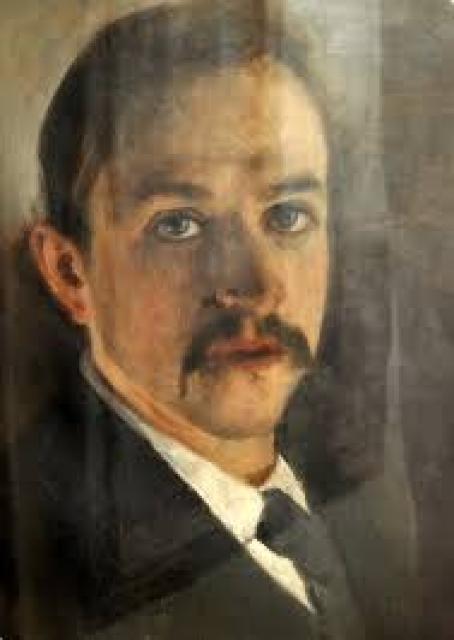
Feodosy Vakhrushov
- Early Life and Education
- Influences and Academy Years
- Career and Artistic Style
- Contributions to Museum Collections
- Later Life and Legacy
Early Life and Education
Fedor Mikhaylovich Vakhrushov was born on February 26, 1870, in Totma, Vologda Governorate, Russia, to Mikhail Akinfovich Vakhrushov and Klavdia Ivanovna. After graduating from the local district school, Vakhrushov worked as a clerk for the police supervisor and briefly apprenticed with a local craftsman painter.
Influences and Academy Years
With the support of a wealthy widow, Vakhrushov moved to Tsarskoye Selo, where he lived with M. N. Vasiliev, an adjunct professor at the Imperial Academy of Arts. He enrolled in the Academy's School of Drawing, Sculpture, and Architecture (1886-1888) and became a non-resident student in 1889. In 1890, Vakhrushov became a full-time student at the Academy and received the title of Class Artist Third Degree in 1894. He studied under Ilya Repin from 1895 to 1897, graduating with a diploma and certification to teach drawing in secondary schools.
Career and Artistic Style
From 1897 to 1913, Vakhrushov lived and worked primarily in Ukraine. In 1914, he returned to Totma, where he built a house for his family. He also established a small hut on an island in the Sukhona River for solitude and inspiration.
Vakhrushov was known for his idyllic landscapes and architectural scenes of the Russian North. He was a member of the Northern Circle of Fine Arts Lovers, which played a significant role in the preservation of cultural heritage in Vologda.
Contributions to Museum Collections
Vakhrushov was instrumental in the development of the Totma Regional Museum. With members of the Totma branch of the Vologda Society for the Study of the Northern Region, he collected folk art and ancient church artifacts. He also led expeditions to collect artifacts and document architectural monuments.
In 1919, Vakhrushov rescued artistic treasures from the ransacked Spaso-Sumorin Monastery near Totma. He collaborated with scientists from the Leningrad Geological Museum on archaeological excavations along the Northern Dvina River.
Later Life and Legacy
Despite attempts to seize his house in 1930, Vakhrushov continued to live and work in Totma until his death. He was affiliated with the Vologda Museum of Iconography, the State Historical Museum in Moscow, and the Museum of Ethnography in Leningrad.
Fedor Mikhaylovich Vakhrushov's legacy as a painter, landscape artist, and museum curator continues to inspire and enrich the cultural landscape of the Russian North.


