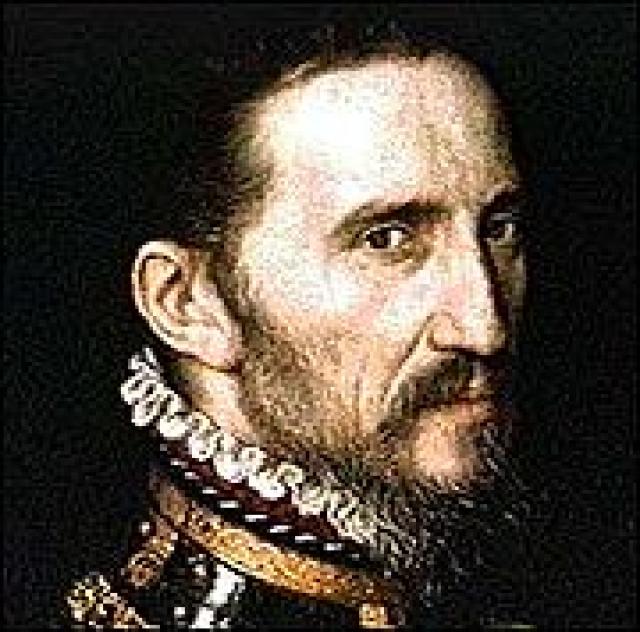
Fernando Alvares de Toledo
 Spain
Spain- Biography of Fernando Alvarez de Toledo
- Early Career
- The Netherlands
- Tyranny and Conflict
- Escalating Violence
- Later Years and Legacy
Biography of Fernando Alvarez de Toledo
Fernando Alvarez de Toledo, a Spanish statesman and military commander, was born into one of the most distinguished Castilian families. His father was killed in a war against the Moors, and young Alvarez was raised by his grandfather, the Duke of Toledo.
Early Career
Due to his character, which combined iron cruelty with a fervent attachment to his king and monarchy, he soon became the most feared and renowned military commander in Europe. At the age of 16, he fought against the French and later participated in all of Emperor Charles V's campaigns in France, Italy, Africa, Hungary, and Germany. In German history, his name is closely associated with the Battle of Mühlberg in 1547. Under his command, a decisive cavalry attack on the wavering Saxon soldiers tilted the victory in favor of the Spanish forces. He was less successful in the war for Metz in 1552, but in 1557, he successfully led troops against Pope Paul IV's army, forcing him to abandon the alliance with the French and realign with Spanish policies.
The Netherlands
Alvarez left an indelible, yet also the bloodiest, memory of himself during his rule in the Netherlands (1567-1573). When he arrived from Spain with a small but elite army to strengthen the Catholic religion and monarchy of King Philip II, the revolution that had started in the Netherlands in 1566 was already nearing its end. Alba was instructed by Philip to capture the country's most prominent citizens, execute them, confiscate their property, and enforce strict adherence to the Catholic faith. The deaths of Prince of Orange, Egmont, Horn, and others were predetermined. However, out of the three leaders, Alba only managed to ensnare Egmont and Horn, arresting them on September 9, 1567. The tribunal was called the "Council of Disorders" but acquired the name "Council of Blood" (Bloedraad) from the people due to Vargas' cynical and harsh guidance.
Tyranny and Conflict
For three months, Alba sent up to 1,800 people to the gallows. Those summoned for questioning were effectively already condemned, with even the slightest suspicion or enemy slander being enough for their execution. The court did not issue any sentences other than death and confiscation of property. The Orange princes, William and Louis, were also summoned to court but wisely did not appear. Instead, in the spring of 1568, they initiated a war from Germany. However, initially, they only worsened the terrible situation in their country. Louis' victory in April 1568 prompted Alba to execute Egmont, Horn, and other prominent figures in June, and he repaid Louis for his victory with two victories and skillful operations that completely expelled him from the country in October 1568.
Escalating Violence
Afterward, the Netherlands experienced another wave of bloody retribution, with the number of executions soon reaching thousands. Property worth 30 million talers was confiscated, trade and industry came to a halt, and hundreds of thousands of people fled across the border. This was followed by oppression through new taxes: in March 1569, state officials in Brussels had to give their consent to three decrees imposing a 1% tax on all movable and immovable property, a 5% tax on the sale of real estate, and a 10% tax on the price of any sold goods. These decrees halted industry, and a political catastrophe became inevitable. Even the amnesty declared on July 4, 1570, did not prevent it, as all the edicts remained in force. When an attempt was made to collect taxes of 20 and 10 pfennigs on July 31, 1571, all shops closed, resulting in a complete halt of trade and industry. The catastrophe erupted on April 1, 1572, with Zealand and Holland separating from Spain, and Louis and William returning to the country. Despite Alba's continued victories in battles, after a year of bloody retribution and fruitless triumphs, he lost hope of achieving his goals. He requested to be relieved of his duties on December 18, 1573, and returned to Spain. There, he performed another important service for his king by conquering Portugal in 1580 during the Iberian Union.
Later Years and Legacy
In his final years, Alba no longer enjoyed the trust of his ruler. This was not surprising, as he was not an obedient servant of the despot. On the contrary, he asserted his aristocratic rights and honors in his dealings with Philip. On one occasion, before this period, when asked about the possibility of conquering Portugal in the presence of the king, he spoke boldly: "And where will our children seek refuge from the king?" According to Ranke's observation, he had an aristocratic inclination to assist despotism, as long as it did not affect him personally. Alba did not long survive his last triumph; he died in Lisbon in 1582.


