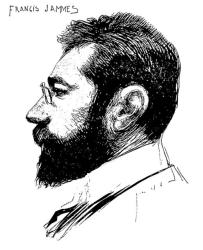
Francis Jammes
 France
Francis Jammes (December 2, 1868–November 1, 1938) was a French poet and novelist whose work celebrated ordinary life, rural landscapes and the natural world. Writing outside the literary centers of Paris, he developed a plainspoken, lyrical style that brought farm animals, village people and familiar countryside into poetry. His return to Catholicism in 1905 gave his later work a stronger religious focus.
Early life and literary beginnings
Jammes was born in Tournay in the Hautes-Pyrénées. After his father’s death in 1888, he moved with his mother to Orthez in Béarn, where he worked briefly in a notary’s office and began publishing poems. The countryside around Orthez became the setting and imaginative world of much of his writing.
His first collections, including *Vers* (1891) and *Six sonnets* (1893), attracted little notice at first. In 1895 he described a sudden surge of poetic inspiration that produced “Un jour,” published the following year. His early writing attracted the attention of André Gide and other literary figures, who helped bring it to a wider audience.
Poetry and prose
Jammes’s major early collection, *De l’Angélus de l’aube à l’Angélus du soir* (1898), established his distinctive voice. Its title refers to the bells marking prayer at dawn and evening, and its poems draw on the rhythms of rural days. He followed it with *Le Deuil des primevères* (1901) and *Le Triomphe de la vie* (1902).
His work also included prose and novels such as *Clara d’Ellébeuse* (1899), as well as the *Roman du lièvre* (1903). Jammes wrote with an apparent simplicity that rejected literary fashion and elevated humble subjects: fields, household life, animals, children and the people of the southwest of France. One of his best-known poems, “Prière pour aller au paradis avec les ânes” (“Prayer to Go to Paradise with the Donkeys”), shows his tenderness toward animals and his spiritual imagination.
Conversion and later work
Jammes returned to Catholicism in 1905, influenced in part by his friendship with the poet and diplomat Paul Claudel. This change expanded the spiritual dimension of his writing without replacing its attention to landscape and daily life. Works such as *Clairières dans le ciel* and *Les Géorgiques chrétiennes* (1912) join rural imagery with Christian faith.
He married Ginette Goedorp in 1907 and continued to write poetry, prose and drama. In 1917, the family moved from Orthez to Hasparren in the Basque Country, where Jammes lived for the rest of his life. His later books included *Le Poète rustique* (1920) and *Le Rêve franciscain* (1927).
Legacy
Jammes died in Hasparren in 1938. His poetry is remembered for its gentle attention to nature and the lives of ordinary people, as well as for its balance of simplicity, humor and religious feeling. He helped shape a modern French lyric poetry rooted in rural experience, and his work continued to influence writers who valued direct language and spiritual seriousness.