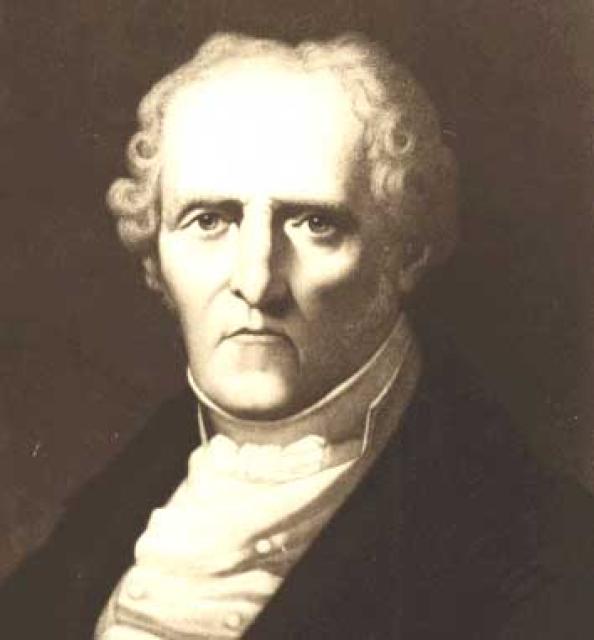
Francois Mari Fourier
 France
- Biography of François Marie Charles Fourier
- Enlightenment and Theory of Four Movements
- Influence and Social Experiment
Biography of François Marie Charles Fourier
François Marie Charles Fourier was a French socialist utopian and philosopher. He was born into a family of clothing merchants and grew up during the period of the French Revolution. Fourier actively participated in the Lyon anti-government uprising during this time. As a result, his family's property was confiscated and he was imprisoned. After some time, he was enlisted for military service. In 1799, Fourier became a traveling salesman.
Enlightenment and Theory of Four Movements
During one of his business trips, Fourier noticed that an apple in a Parisian restaurant cost one hundred times more than in Besançon. This observation served as an enlightening moment for him, leading to the comprehension of the essence of a "new social order." Fourier made several attempts to garner support for his concepts from official figures, but was unsuccessful. In 1808, he published his main work, "The Theory of Four Movements and General Destinies." According to Fourier, the ideal social organization is based on the concept of the "phalanx." The phalanx embodies the idea of universal brotherhood and is founded on the alignment of individual and collective interests. It is primarily agriculturally based but also involves interaction with industrial production. A phalanx consists of 1700 to 2000 individuals. Each person's abilities complement one another, forming the basis for collective and individual happiness. Working in a phalanx is attractive because labor aligns with each person's abilities and inclinations. Work brigades are formed based on mutual love. Each brigade represents a "series" in psychological terms. While they view other "series" as competitors, there is no hostility typical of class societies. It was assumed that phalanx members could change occupations, fulfilling their "instincts for pleasant change." Through various activities, individuals can experience feelings of love, competition, or participation in the "kabbalistic." Fourier used this term to refer to an attraction to something mysterious and enigmatic. He believed that these instincts should be perceived as a God-given gift to be liberated, rather than suppressed, as they are in modern society, where they turn into destructive passions.
Influence and Social Experiment
Throughout his life, Fourier revised and refined his ideas, introducing new terms and theories into his "system." His most significant later works include "Treatise on Domestic and Agricultural Association" (1822), "The New Industrial and Societary World" (1829), and "False Industry" (1835-1836). Based on his ideas, the "societary school" emerged, with Victor Considerant becoming one of its adherents. By the mid-19th century, Fourier's system, modified and clarified, exerted a noticeable influence on thinkers striving to find a new social ideal. Fourier's followers conducted a social experiment in the United States at the renowned Brook Farm in Roxbury, Massachusetts.