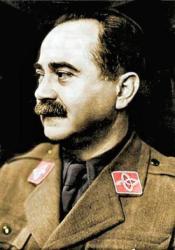
Marcelo Caetano
 Portugal
Marcelo Caetano: Portugal's Prime Minister in the Late Salazarist Regime
Early Life and Career
Marcelo José das Neves Alves Caetano was born in Lisbon, Portugal in 1906. He studied law and entered government service in the Ministry of Finance in 1932. Under the authoritarian regime of António Salazar, Caetano became a close associate, assisting in the drafting of the foundational documents of Salazar's "Estado Novo" (New State).
Administrative Posts
Caetano held various administrative posts in the Portuguese government, including Director-General of Education (1939-1949) and Minister of the Colonies (1951-1955). In these roles, he played a significant role in shaping Portugal's policies on education and colonial administration.
Appointment as Prime Minister
In September 1968, following Salazar's incapacitating stroke, Caetano was appointed Prime Minister by the Council of State. As Prime Minister, he largely continued Salazar's policies, maintaining a conservative approach to domestic and foreign affairs. However, he introduced some cautious reforms, such as increasing representation of opposition parties in the National Assembly.
Overthrow and Exile
In April 1974, Caetano's government was overthrown in the peaceful "Carnation Revolution." Facing pressure from the military and popular protests, Caetano resigned and fled to Brazil, where he lived in exile until his death in 1980.
Legacy
Marcelo Caetano is remembered as a pragmatist who attempted to modernize Salazar's authoritarian regime while preserving its core principles. Despite his efforts, his inability to fully address the growing demands for political and social change ultimately contributed to the downfall of the Estado Novo.