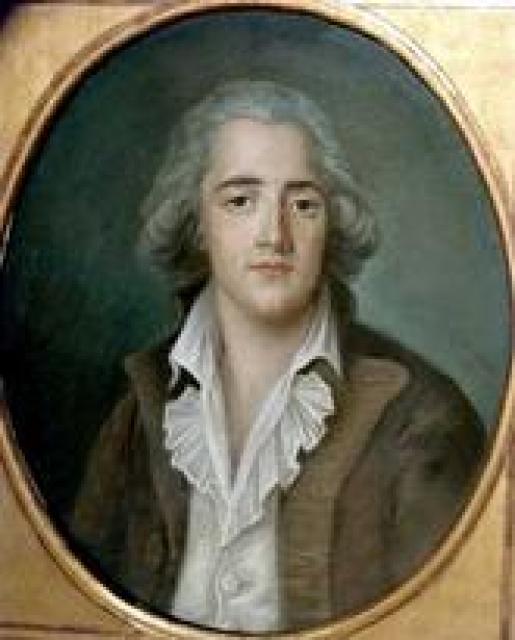
Francois-Rene de Chateaubriand
 France
Biography of François-René de Chateaubriand
François-René de Chateaubriand was a French writer and politician. He was born on September 4, 1768, in Saint-Malo, Brittany. He spent his childhood near the sea and in the gloomy medieval castle of Combourg. Despite initially considering a career as a naval officer or clergyman, Chateaubriand became a junior lieutenant in the Navarre Regiment in 1788. Inspired by stories of great travelers, he sailed to America and spent five months there from July to December 1791. This trip later inspired him to create his major works.
Upon hearing news of Louis XVI's arrest, Chateaubriand returned to France. After marrying a woman from his social circle, he joined the army of the princes in Koblenz and participated in the Siege of Thionville. After recovering from a wound, he made his way to England, where he lived for seven years from 1793 to 1800. It was during this time that he published his first work, "Essay on Revolutions" (Essai sur les révolutions, 1797).
Returning to France in 1800 under a different name, Chateaubriand gained public recognition the following year with his novel "Atala, or the Love of Two Savages in the Wilderness" (Atala, ou les amours de deux sauvages dans le désert, 1801). This novel stood out for its harmonious and picturesque style, as well as its innovative depiction of passion against the backdrop of the exotic lives of native Americans. Originally, Chateaubriand intended to include this novel in his treatise "The Genius of Christianity" (Le Génie du christianisme, 1802), which became the quintessence of his work. In his later works, he either developed or commented on the plots outlined in this treatise. The main idea of the treatise is that Christianity is the most poetic and humane of all religions, favoring freedom, art, and literature more than others. The significance of this book for the romantic movement cannot be overstated, as an entire generation of writers found an inexhaustible source of literary ideas and inspiration in "The Genius of Christianity".
Chateaubriand's novel "René" (1802), intended to illustrate the "confusion of passions", served as a model for melancholic heroes tormented by a malaise later known as the "mal du siècle" or "sickness of the century". Not content with literary fame, Chateaubriand entered the service of Napoleon, but after the assassination of the Duke of Enghien, he did not hesitate to resign from his position and withdrew from politics until the return of the Bourbons. He played an important role in their restoration, publishing the pamphlet "On Bonaparte and the Bourbons" (De Buonaparte et des Bourbons, 1814). After the Restoration, Chateaubriand served as ambassador to Berlin (1821), London (1822), and Rome (1828). As Minister of Foreign Affairs (1823), he provoked a war with Spain. With the ascension of Louis-Philippe, he permanently retired from public life.
During this period, his epic "The Martyrs" (Les Martyrs, 1809) was published, narrating the conflict between Christianity and paganism in the time of Diocletian. In search of local color for "The Martyrs," Chateaubriand embarked on a trip to Greece and the Middle East, recounting his experiences and incidents in the book "Itinerary from Paris to Jerusalem" (Itinéraire de Paris à Jérusalem, 1811). He also transformed his notes from his time in America into the epic "The Natchez" (Les Natchez, 1826), continuing the story of René among the Native American tribes. Of greatest interest to contemporary readers are his "Memoirs from Beyond the Grave" (Mémoires d'outre-tombe), written between 1814 and 1841 but published shortly after his death on July 4, 1848, in Paris. Despite their unevenness and questionable accuracy, Chateaubriand's memoirs provide a vivid picture of the romantic era.