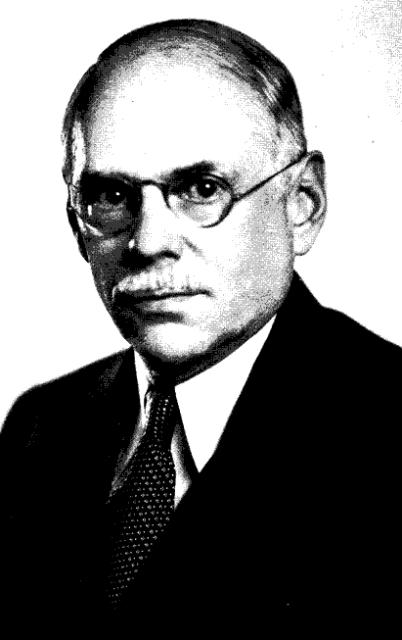
Frank Knight
 USA
USA- Biography of Frank H. Knight
- Early Life and Education
- Academic Career
- Contributions to Economic Thought
Biography of Frank H. Knight
Frank H. Knight was an American economist who played a crucial role in shaping the field of economics in the first half of the 20th century. He was the founder of the Chicago School of Economics and authored numerous publications in professional journals. Knight gained a reputation as a talented economist primarily through his book "Risk, Uncertainty and Profit," published in 1921. This book was based on his doctoral dissertation, which he defended at Cornell University. In his dissertation, Knight argued that perfect competition does not eliminate profit due to uncertainty.
Early Life and Education
Frank Knight was born on November 7, 1885, in McLean County, Illinois. He passed away in Chicago on April 15, 1972, at the age of 86. He attended Cornell University, where he completed his doctoral studies and earned his Ph.D. in economics.
Academic Career
Knight served as a professor of economics at the University of Chicago from 1927 to 1955. After his retirement, he remained an eminent professor until his death. Notably, Milton Friedman, the Nobel laureate, was a student of Knight during his time at the University of Chicago. Knight held influential positions within the economics faculty at the university during the development of the differential approach to economic analysis, which became synonymous with the Chicago School of Economics.
Contributions to Economic Thought
Knight was an economist by training but also had a deep interest in social philosophy and history. He built his career by presenting his economic views in opposition to progressives, institutionalists, Keynesians, and Christian economists who advocated for social control in the name of science or morality.
Knight believed that liberal societies were always under threat from those who claimed to know what was best for society based on moral or scientific grounds, as this often led to totalitarian regimes. He argued that what liberal societies truly needed was vigilance to protect the ongoing discussion of their existence and wise leadership to maintain the quality of that discussion.
While knowledge of the fundamentals of economic theory was an essential component of intellectual discourse, Knight believed that economics played a small role in determining a well-functioning liberal society.
Knight is renowned for introducing the concept of Knightian uncertainty and distinguishing it from the concept of risk. He also gained recognition for his famous debate on social costs with the English economist Arthur Cecil Pigou.
Overall, Frank H. Knight's contributions to economics and his advocacy for the preservation of open and diverse discussions within liberal societies have had a lasting impact on the field of economics and social philosophy.


