Frantsisko Hose Goya
 Spain
SpainBiography of Francisco José Goya
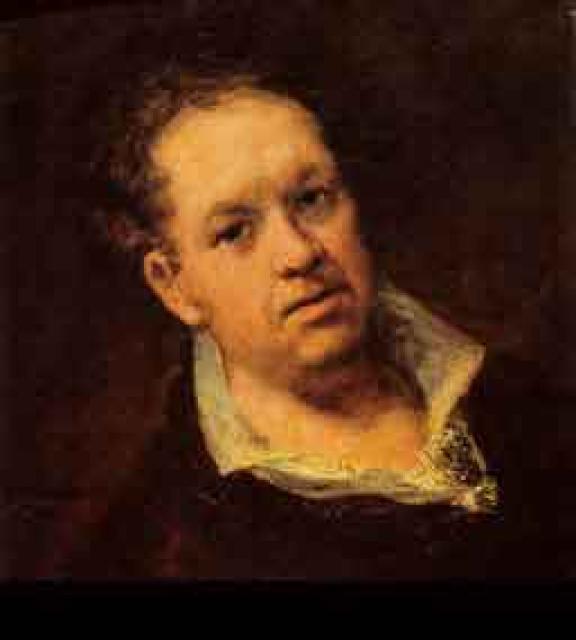
Francisco José de Goya y Lucientes, a Spanish artist, was ahead of his time as an artist, to the extent that his works almost always seem to be created by our contemporaries. With the exception of a few works, all of his art is a bold exploration, genuine innovation, and social and revolutionary commentary.

Goya was born in 1746 in Fuendetodos, a small town near Zaragoza, and grew up in a humble family. In 1760, his family moved to Zaragoza, where he began studying painting under the artist José Luzán y Martínez. After a few years, Goya got involved in a bloody street fight and was forced to flee Zaragoza. In 1766, he arrived in Madrid, where he became acquainted with the works of court painters, honed his skills, and even participated in competitions held by the Madrid Academy of Fine Arts. However, another violent altercation led Goya to flee again, this time with a troupe of bullfighters led by José Delgado. After some time, the young artist found himself in Rome, where he familiarized himself with the works of Italian masters. However, his passion for adventures and escapades once again caused trouble when he broke into a convent at night to abduct his lover. Caught in the act, he was forced to leave Rome.

In 1771, Goya returned to Zaragoza, stopping in Parma along the way, where he participated in a competition held by the Parma Academy on the theme "Hannibal Contemplating Italy from the Alps." Goya completed the painting in three days and received the second prize. From 1771 to 1772, the artist executed frescoes in the Baroque tradition for the church of Nuestra Señora del Pilar in Zaragoza. In 1773, Goya moved to Madrid. He was married to Josefa Bayeu, the sister of the court painter Francisco Bayeu. Their marriage lasted about forty years but was not happy due to Josefa's infidelity and her wife's difficult character. Out of their numerous offspring (according to various sources, they had between 12 to 22 children), only five survived, and only one of them, Francisco Javier Pedro, became an artist. Goya's connections with the Bayeu family proved extremely beneficial for his career. He was accepted into the highest circles of Madrid society and received lucrative commissions. His exceptional powers of observation made him particularly adept at portraiture, and excellent examples of his work can now be seen in the Prado Museum in Madrid. The majority of his other highly original and nationalistic works are located in Spain. Outside of Spain, he is primarily known for his etchings characterized by intellect, patriotism, irony, and sharp criticism. These etchings are grouped into series titled "Caprichos" (1793-1798, 80 plates, featuring compositions that satirize or condemn the vices of the aristocracy, the Inquisition, monastic life, and Spanish customs), "Bullfighting from the Time of Sid" (around 1801, 80 plates), "Proverbs" (18 plates, serving as a continuation of the "Caprichos"), and "The Disasters of War" (1810-1815, 80 plates, depicting scenes from the horrors of the French invasion of Spain under Napoleon I). In addition to these series, Goya also created many other engravings of his own designs, often using strong alcoholic acid, as well as prints inspired by paintings of his beloved Velázquez. His career continued successfully, and in 1795, he became the president of the academy. Neither the French invasion of Spain nor the restoration of the Spanish monarchy harmed him. However, the Inquisition disapproved of his unconventional interpretations of religious subjects and the painting "The Nude Maja" as nudity was not accepted by the Inquisition. Legend attributes Goya with a passionate temperament and various love affairs, the most popular being his relationship with the Duchess of Alba, a powerful and exceptionally wealthy aristocrat whom he was infatuated with. It is believed that the "Nude Maja" and "Clothed Maja" are portraits of the duchess, although many scholars have doubts about this. In the early 1790s, Goya's worldview drastically changed, and his works lost their former optimistic tone. The crisis in the artist's work was exacerbated by a severe illness that resulted in complete deafness. It was a cruel blow for Goya.
Much has been written about Goya's engravings, such as "Caprichos" and "The Disasters of War." Serious studies have meticulously traced the fate of each character depicted. Goya left signatures on most of his engravings, and art historians consider them to be a kind of commentary. However, it should be noted that such texts by artists sometimes serve not to reveal the meaning of the work but rather as a form of disguise. A seemingly innocent signature by Goya, whether in the form of a fairytale character or a simple joke, hides great political significance. Each of Goya's engravings is permeated with ruthless sarcasm, where fantasy coexists with genuine realism, which is characteristic of all Spanish art. The witches flying to their Sabbath, the idle fools listening to a bird, the hero from the famous tale "The Foolish Man Carrying an Ass on his Back"... They all have a second, hidden meaning.

Among Goya's engravings in the Hermitage is "The Sleep of Reason Produces Monsters." It depicts humanoid creatures with poorly constructed wooden boxes in place of heads, each of them locked with a heavy padlock. And among these "beauties" is a figure with donkey ears and a tied mouth... Indeed, contrary to the inscription, this engraving speaks not about lazy and stupid people, but rather about scoundrels, the wealthy, who have locked up their emotions because these emotions might interfere with the eternal pursuit of wealth. The witches flying to their Sabbath and the witches preening themselves, the monsters devouring each other, the terrifying figures in hoods - all of this is not simple and naive mockery of superstitions or the beliefs of his compatriots. No, this is the reality itself, the country transformed into a vast dungeon or a madhouse.
It is no coincidence that the witches in Goya's etchings resemble society ladies, and the story of the man carrying an ass makes one think about the common people burdened by a horde of oppressors!
Goya was a humanist in our understanding of the term. He sympathized with the ideas of the French Revolution and despised the conquering pretentiousness of the French bourgeoisie. The king called him an atheist and believed that he deserved the gallows. Goya was threatened with punishment by representatives of the Holy Inquisition. However, he remained a bold and determined person, ready to defend his rights and beliefs.
Francisco José Goya, as an artist, was ahead of his time to such an extent that his works almost always appear to be created by our contemporaries. With the exception of a few works, his entire body of work represents a bold exploration, genuine innovation, and social and revolutionary critique.