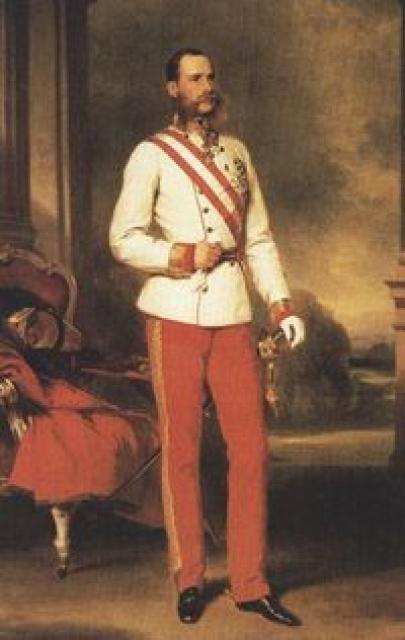
Franz Josef I
 Austria
- Biography of Franz Joseph I
- Early Life and Ascension to the Throne
- Marriage and Family Tragedies
- Reign and Legacy
- Legacy and Titles
Biography of Franz Joseph I
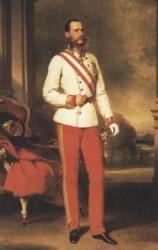
Franz Joseph I (18 August 1830 - 21 November 1916) was the Emperor of the Austro-Hungarian Empire and the Apostolic King of Hungary. He ruled for 68 years and his reign was a significant era in the history of the nations within the Danube Monarchy.
Early Life and Ascension to the Throne
Franz Joseph I was born on August 18, 1830, in Laxenburg, Austria. He was the eldest son of Archduke Franz Karl, the son of Franz II, and the younger brother of Ferdinand I. In 1848, during the Austrian Revolution, his uncle abdicated the throne and his father renounced his rights of succession. At the age of 18, Franz Joseph I became the ruler of the multinational Habsburg Empire.
Marriage and Family Tragedies
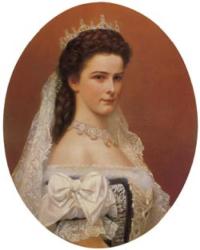
In 1854, Franz Joseph I married Princess Elisabeth of Bavaria, also known as "Sisi" or "Sissi." They had one son, Crown Prince Rudolf, who tragically committed suicide in 1889 at Mayerling after killing his lover, Baroness Mary Vetsera. This was not the only family tragedy that befell Franz Joseph I. In 1867, his brother Maximilian, who had been proclaimed Emperor of Mexico, was executed by republicans. In 1898, Empress Elisabeth was assassinated in Geneva by an Italian anarchist named Luigi Lucheni. In 1914, the Archduke Franz Ferdinand, the new heir to the throne and Franz Joseph I's nephew, was assassinated along with his wife by a Serbian terrorist named Gavrilo Princip. This event marked the beginning of World War I, which ultimately led to the downfall of Franz Joseph I's empire.
Reign and Legacy
Throughout his long reign, Franz Joseph I was known for his conservatism, simplicity in daily life, and adherence to etiquette and traditions. He considered himself the "last monarch of the old school." After his brother's execution in Mexico, he refused to receive Mexican diplomats for the rest of his life. He resisted the introduction of telephones into his palace and reluctantly accepted electricity. When his son took his own life, Franz Joseph I wrote to all European monarchs claiming that the crown prince's death was the result of an accidental gunshot during a hunting trip, but he told Pope Leo XIII the truth. It is often said that the Austrians, Hungarians, and Czechs still have early morning routines and early bedtimes because Franz Joseph, an early riser, imposed his schedule on the entire empire.
Legacy and Titles
Franz Joseph I's legacy extends beyond his long reign. In his honor, the Franz Josef Land, an archipelago belonging to Russia, was named after him by an Austrian polar expedition in 1873. His full imperial and royal title was His Imperial and Apostolic Majesty Franz Joseph I, by the grace of God Emperor of Austria, King of Hungary and Bohemia, King of Lombardy and Venetia (the Lombardy and Venetia title was removed in 1869 after the unification of Italy), Dalmatia, Croatia, Slavonia, Galicia and Lodomeria, and Illyria, King of Jerusalem, etc.; Archduke of Austria; Grand Duke of Tuscany and Cracow; Duke of Lorraine, Salzburg, Styria, Carinthia, Carniola, and Bukovina; Grand Prince of Transylvania; Margrave of Moravia; Duke of Upper and Lower Silesia, Modena, Parma, Piacenza, and Guastalla, Auschwitz and Zator; Prince of Teschen, Friuli, Ragusa (Dubrovnik), and Zara; Sovereign Prince of Trieste, Cattaro, and the Windic March; and many other titles.
Franz Joseph I was the last monarch in history to exercise the veto power. He used his veto at the Papal Conclave of 1903 to prevent the election of Cardinal Rampolla del Tindaro as Pope. The veto was proclaimed on behalf of the emperor by Cardinal Puzyna of Krakow. The cardinals were unable to contest Franz Joseph, the only monarch who had never clashed with the popes. Giuseppe Sarto was ultimately elected as Pope Pius X, who later abolished the emperor's veto power.